

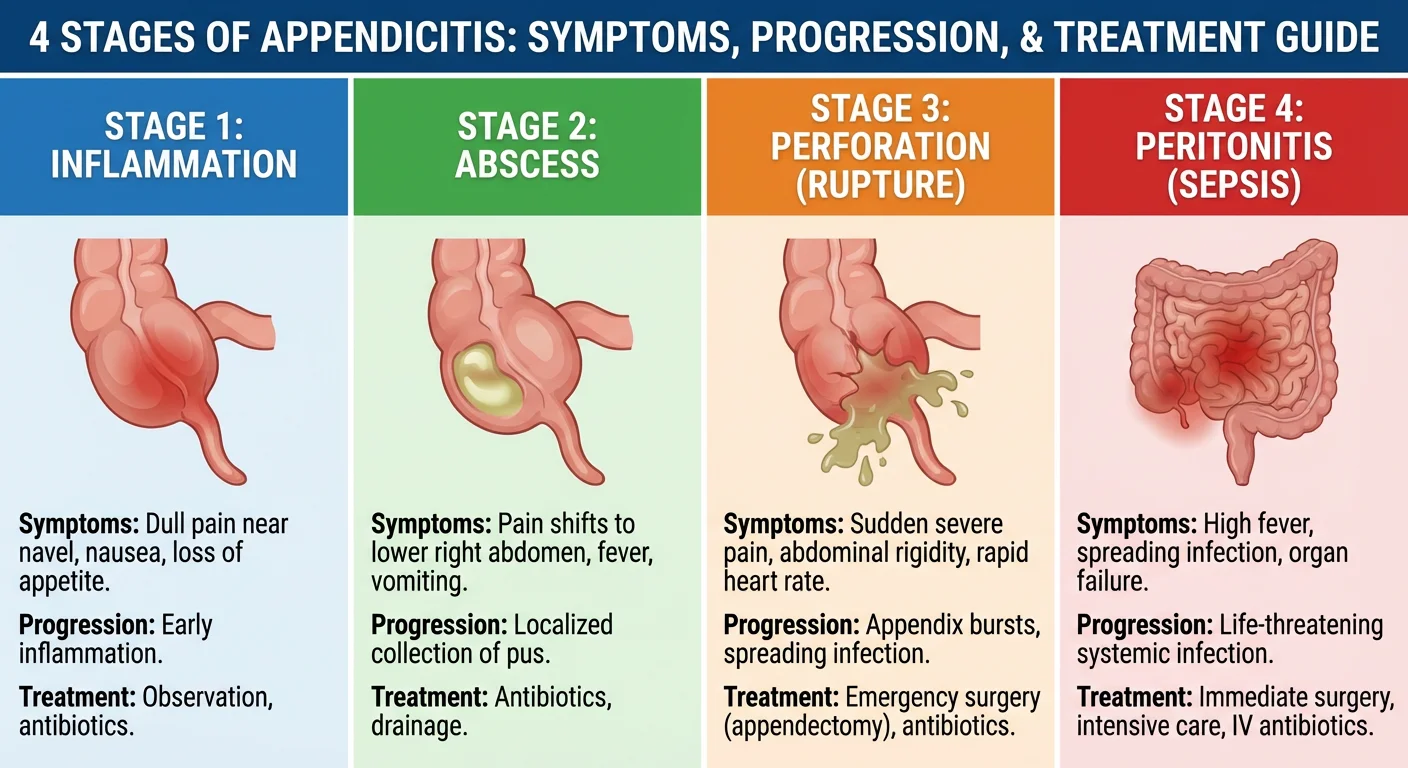
The 4 stages of appendicitis represent a critical medical progression that can advance from mild inflammation to life-threatening infection within 24-72 hours. Understanding appendix inflammation as it evolves through catarrhal appendicitis, phlegmonous appendicitis, gangrenous appendicitis, and perforated appendicitis helps patients recognize appendicitis red flags early and seek emergency care before serious appendicitis complications develop.
Appendicitis occurs when the appendix—a small, finger-shaped pouch attached to the large intestine in the lower right abdomen—becomes blocked, typically by fecal matter, infection, or inflammation. This obstruction of appendix triggers bacterial overgrowth, leading to progressive inflammation, ischemia (reduced blood flow), necrosis (tissue death), and potentially perforation that releases infectious material into the abdominal cavity.
Whether you’re experiencing lower right abdominal pain yourself, concerned about pediatric appendicitis symptoms in a child, or seeking to understand appendicitis treatment urgency for an elderly family member, this comprehensive guide examines each stage’s distinct characteristics, early appendicitis symptoms, imaging for appendicitis, surgical intervention options, and postoperative care requirements based on current medical standards.
Key Takeaways
- The 4 stages of appendicitis progress from catarrhal appendicitis through phlegmonous, gangrenous, and perforated stages over 24-72 hours
- Characteristic symptom progression includes periumbilical pain migrating to lower right abdomen at McBurney’s point, with increasing fever, abdominal tenderness, and systemic illness
- Early diagnosis through physical examination and imaging for appendicitis enables emergency appendectomy before dangerous complications develop
- Perforated appendicitis creates life-threatening peritonitis and sepsis requiring immediate surgical intervention and intensive postoperative care
- Recognizing appendicitis red flags and seeking emergency evaluation prevents progression to advanced stages with significantly higher complication rates
What is Appendicitis? Understanding the Condition
Appendicitis is inflammation of the appendix requiring emergency medical evaluation and typically surgical removal (appendectomy). The condition affects approximately 1 in 20 people during their lifetime, occurring most commonly between ages 10-30, though pediatric appendicitis and elderly appendicitis present unique diagnostic challenges.
The appendix has no known essential function in humans, though it may play minor roles in immune function. When blocked by hardened stool (fecalith), lymphoid tissue swelling, parasites, or tumors, bacteria multiply rapidly within the closed appendix, triggering the inflammatory cascade that defines appendicitis progression.
Without treatment, appendicitis advances through increasingly severe stages over hours to days, with perforation risk increasing significantly after 48-72 hours of symptom onset. Rapid progression appendicitis can occur faster in certain populations, making prompt medical evaluation critical when symptoms appear.
Stage 1: Catarrhal Appendicitis (Simple/Early Appendicitis)
Timeline and Pathophysiology
Catarrhal appendicitis represents the initial inflammation stage, typically occurring within the first 12-24 hours after obstruction. At this early stage, the appendix becomes swollen and congested with increased mucus production and mild inflammation limited to the inner lining (mucosa) of the appendix.
Bacterial overgrowth begins within the blocked appendix, triggering immune responses that increase blood flow and white blood cell accumulation. The appendix remains intact without significant tissue damage, making this the most favorable stage for intervention.
Early Appendicitis Symptoms
Initial symptoms often begin vaguely, which can delay diagnosis. Characteristic early appendicitis symptoms include:
Periumbilical pain: Dull, cramping discomfort around the belly button area that patients often describe as indigestion or gas pain. This localized vs generalized pain pattern occurs because the appendix shares nerve pathways with the small intestine.
Nausea and vomiting: Loss of appetite typically appears first, followed by nausea. Vomiting may occur but isn’t always present.
Mild fever: Low-grade temperature elevation (99-100°F) may develop, though some patients remain afebrile in this early stage.
General malaise: Feeling unwell, tired, or “off” without being able to identify specific problems.
Diagnosis at Stage 1
Early diagnosis proves challenging because symptoms mimic common digestive complaints. Physical examination may reveal minimal abdominal tenderness without the classic signs that develop later.
Imaging for appendicitis at this stage may show subtle appendix swelling on ultrasound appendix examination or CT scan appendix imaging, though findings can appear normal or inconclusive. Blood tests typically show mild elevation in white blood cell count.
Treatment Approach
When diagnosed at the catarrhal stage, emergency appendectomy remains the standard treatment, though some cases may respond to antibiotic treatment appendicitis protocols without surgery. Research suggests antibiotics alone may resolve up to 60-70% of early uncomplicated cases, though recurrence risk exists.
Surgical intervention at this stage offers straightforward procedures with minimal complications, shorter operative time, and faster recovery compared to later stages.
Stage 2: Phlegmonous Appendicitis (Suppurative Appendicitis)
Timeline and Pathophysiology
Phlegmonous appendicitis develops 24-48 hours after initial obstruction and represents the most commonly encountered stage at time of diagnosis. The inflammation extends through all layers of the appendix wall, with significant pus formation (suppuration) and marked swelling.
Bacterial infection intensifies, with neutrophils (infection-fighting white blood cells) infiltrating the entire appendix wall. The organ becomes edematous (fluid-filled), and small abscesses may form within the appendix tissue itself.
Characteristic Symptoms
At this stage, symptoms become more specific and severe:
Migration of pain: The hallmark pattern where periumbilical pain shifts to the lower right abdomen at McBurney’s point (located one-third of the distance from the anterior superior iliac spine to the umbilicus). This localized vs generalized pain transition reflects peritoneal irritation as inflammation reaches the outer appendix layer.
Abdominal tenderness: Direct pressure over McBurney’s point produces significant discomfort. Rebound tenderness develops—pain that worsens when pressure is suddenly released rather than when applied.
Guarding: Involuntary abdominal muscle contraction when the lower right abdomen is touched, representing the body’s protective response.
Fever: Temperature typically rises to 100-102°F as systemic inflammatory responses intensify.
Nausea and vomiting: These symptoms persist or worsen, and patients typically cannot eat.
Physical Examination Findings
Medical providers assess multiple clinical signs:
- Rovsing’s sign: Pain in the right lower quadrant when the left lower abdomen is pressed
- Psoas sign: Pain when the right hip is extended, suggesting appendix inflammation near the psoas muscle
- Obturator sign: Pain with internal rotation of the flexed right hip
These findings help confirm appendicitis diagnosis and differentiate it from other conditions causing abdominal pain.
Diagnostic Confirmation
Imaging for appendicitis becomes more definitive at this stage. Ultrasound appendix examination may show a dilated, thick-walled appendix with surrounding fluid. CT scan appendix imaging provides greater detail, revealing an enlarged appendix (>6mm diameter), periappendiceal fat stranding, and potential small fluid collections.
Laboratory findings include elevated white blood cell count (typically 10,000-18,000 cells/μL) and elevated C-reactive protein indicating significant inflammation.
Treatment Protocols
Emergency appendectomy becomes increasingly urgent at the phlegmonous stage. Most surgeons recommend surgery within 12-24 hours of diagnosis rather than immediate emergency surgery, allowing time for fluid resuscitation and antibiotic administration.
Laparoscopic appendectomy (minimally invasive surgery using small incisions) is preferred when feasible, offering faster recovery than open surgery. However, significant inflammation may necessitate open appendectomy for safer tissue handling.
Antibiotic treatment appendicitis coverage typically includes broad-spectrum antibiotics targeting common intestinal bacteria (E. coli, Bacteroides species) started before surgery and continued afterward.
Stage 3: Gangrenous Appendicitis
Timeline and Pathophysiology
Gangrenous appendicitis develops 48-72 hours after initial obstruction when inflammation and swelling compress blood vessels supplying the appendix. This ischemia (inadequate blood supply) causes necrosis—actual tissue death—in portions of the appendix wall.
The appendix appears dark, discolored, and extremely fragile at this stage. Dead tissue provides no barrier against bacterial spread, and abscess formation may occur in surrounding tissues as infection extends beyond the appendix itself.
Advanced Symptoms
Patients with gangrenous appendicitis present with severe illness:
Intense pain: Severe, constant lower right abdominal pain that may temporarily decrease as nerve endings die but then worsens as peritonitis develops.
High fever: Temperature often exceeds 102°F, reflecting systemic infection.
Abdominal rigidity: The abdomen becomes board-like and rigid as peritoneal inflammation spreads.
Tachycardia: Elevated heart rate (>100 beats per minute) indicates systemic stress responses.
Toxic appearance: Patients appear acutely ill, pale, sweaty, and anxious.
Complications Emerging
At the gangrenous stage, appendicitis complications become significant concerns:
Abscess formation: Pockets of pus collect around the appendix as the body attempts to wall off infection.
Localized peritonitis: Inflammation of the peritoneum (abdominal lining) begins, initially limited to the area surrounding the appendix.
Sepsis risk: Bacteria entering the bloodstream can trigger systemic inflammatory response syndrome (SIRS) and sepsis.
Diagnostic Findings
CT scan appendix imaging clearly demonstrates gangrenous changes including focal areas of wall thickening with decreased enhancement (indicating dead tissue), periappendiceal abscess collections, and extensive inflammatory changes in surrounding fat and tissues.
Laboratory studies show marked leukocytosis (white blood cell count often >18,000), elevated lactate suggesting tissue hypoxia, and electrolyte abnormalities from vomiting and fluid shifts.
Urgent Treatment Requirements
Gangrenous appendicitis constitutes a true surgical emergency requiring emergency appendectomy within hours, not days. Surgical intervention appendicitis at this stage becomes technically more challenging due to friable (easily torn) tissues and inflammatory adhesions to surrounding structures.
Preoperative resuscitation with intravenous fluids and broad-spectrum antibiotics is critical before surgery. Some patients require ICU care after surgery for close monitoring of sepsis and fluid management.
When large abscesses exist, surgeons may opt for percutaneous drainage (inserting a drain through the skin to remove pus) followed by interval appendectomy 6-8 weeks later after inflammation resolves, rather than immediate surgery in severely contaminated fields.
Stage 4: Perforated Appendicitis
Timeline and Catastrophic Progression
Perforated appendicitis represents the most dangerous stage, typically occurring 48-72+ hours after initial symptoms when gangrenous tissue actually ruptures, releasing bacteria, pus, and fecal material into the abdominal cavity.
Perforation may occasionally occur earlier with rapid progression appendicitis, particularly in pediatric appendicitis (where smaller appendix diameter accelerates progression) and elderly appendicitis (where decreased immune response and atypical symptoms delay diagnosis).
Life-Threatening Presentation
Perforated appendicitis symptoms often include:
Temporary pain relief: Paradoxically, some patients experience brief pain improvement immediately after perforation as pressure within the appendix releases, followed by rapidly worsening diffuse abdominal pain.
Generalized peritonitis: Infection spreads throughout the abdominal cavity, causing diffuse abdominal tenderness, severe abdominal rigidity, and guarding across the entire abdomen rather than just the right lower quadrant.
Severe systemic infection: High fever (>103°F), rapid heart rate, low blood pressure, confusion, and other signs of sepsis emerge as bacteria spread systemically.
Visible illness: Patients appear critically ill with pallor, diaphoresis (excessive sweating), rapid shallow breathing, and altered mental status in severe cases.
Critical Complications
Perforated appendicitis creates multiple life-threatening appendicitis complications:
Diffuse peritonitis: Widespread peritoneal inflammation requires extensive surgical washout and prolonged antibiotic therapy.
Intra-abdominal abscess: Multiple pus collections form throughout the abdomen, often requiring CT-guided drainage in addition to surgery.
Sepsis and septic shock: Overwhelming systemic infection can cause organ failure, requiring ICU care with vasopressor medications to maintain blood pressure.
Bowel obstruction: Inflammatory adhesions can cause intestinal blockage requiring additional surgical interventions.
Death: While modern surgical care has reduced mortality significantly, perforated appendicitis still carries 1-5% mortality risk, higher in elderly patients and those with delayed treatment.
Emergency Diagnostic and Treatment Protocols
CT scan appendix imaging shows frank perforation with free air or fluid in the abdomen, appendicolith (stone from the appendix) outside the appendix, and extensive peritoneal contamination.
Emergency appendectomy must occur immediately with perforated appendicitis. Open surgery is often required rather than laparoscopic approach due to extensive contamination requiring thorough abdominal washout.
Appendicitis treatment urgency cannot be overstated—patients need:
- Immediate fluid resuscitation
- Broad-spectrum intravenous antibiotics covering anaerobic and aerobic bacteria
- Pain management
- Surgical consultation and operating room preparation
- Possible ICU bed reservation
Postoperative Care Requirements
Postoperative care after perforated appendicitis is extensive:
- Hospital stay typically 5-10 days rather than 1-2 days for uncomplicated appendicitis
- Prolonged antibiotic courses (7-14 days)
- Drain placement to remove ongoing fluid collections
- Nutritional support as normal eating resumes slowly
- Monitoring for complications including wound infection, abscess recurrence, and adhesive bowel obstruction
ICU care may be necessary for septic patients requiring mechanical ventilation, vasopressor support, or continuous monitoring.
Special Populations and Appendicitis Variations
Pediatric Appendicitis
Appendicitis in children presents unique challenges. Pediatric appendicitis progresses more rapidly due to thinner appendix walls and less developed omentum (fatty tissue that can wall off infections). Young children cannot articulate symptoms clearly, and parents may initially attribute symptoms to common stomach bugs.
Diagnosis requires high clinical suspicion combined with ultrasound appendix imaging (preferred over CT to avoid radiation exposure) and close observation. Emergency appendectomy in children has excellent outcomes when performed promptly.
Elderly Appendicitis
Elderly appendicitis carries higher mortality (up to 15%) due to delayed presentation, atypical symptoms, and increased perforation rates. Older adults may have minimal fever, vague abdominal discomfort rather than classic pain, and multiple comorbid conditions complicating diagnosis and treatment.
Lower threshold for imaging and surgical consultation is appropriate in elderly patients with any abdominal complaints, as waiting for classic symptoms may result in advanced disease at diagnosis.
Postpartum Appendicitis and Pregnancy
Postpartum appendicitis can occur after delivery when the uterus returns to normal size, potentially unmasking appendicitis that developed during late pregnancy. Pregnant patients pose diagnostic challenges as the enlarging uterus displaces the appendix upward, changing typical pain location and making physical examination difficult.
MRI provides safe imaging during pregnancy when appendicitis is suspected, avoiding radiation while maintaining diagnostic accuracy.
Preventing Progression: When to Seek Emergency Care
Recognizing appendicitis red flags enables timely medical evaluation:
- Abdominal pain that migrates from around the belly button to the lower right abdomen
- Pain that worsens with movement, coughing, or jarring
- Fever combined with abdominal pain
- Inability to eat or drink due to nausea
- Vomiting with abdominal pain
- Abdominal tenderness that worsens when pressure is released (rebound tenderness)
Do not use laxatives or enemas if appendicitis is suspected, as these can trigger perforation. Avoid eating or drinking (in case emergency surgery becomes necessary) and seek immediate emergency department evaluation.
Recovery and Long-Term Outlook
Uncomplicated Appendicitis Recovery
Patients undergoing emergency appendectomy for early-stage (catarrhal or phlegmonous) appendicitis typically recover quickly:
- Hospital stay: 1-2 days
- Return to light activities: 1-2 weeks
- Full recovery: 3-4 weeks
- Laparoscopic surgery generally allows faster return to normal activities than open surgery
Complicated Appendicitis Recovery
Recovery from gangrenous or perforated appendicitis requires extended time:
- Hospital stay: 5-10+ days
- Multiple imaging studies to monitor abscess resolution
- Prolonged antibiotic therapy
- Gradual return to normal diet over weeks
- Potential for readmission if complications develop
- Full recovery: 6-12 weeks
Long-Term Prognosis
Once the appendix is removed, appendicitis cannot recur. Long-term outlook is excellent for patients treated promptly. Those experiencing perforated appendicitis with extensive peritonitis may have increased risk of future adhesive bowel obstructions but generally return to completely normal function.
Frequently Asked Questions
How quickly does appendicitis progress through the four stages? Progression typically occurs over 24-72 hours, though rapid progression can happen in 12-24 hours, particularly in children and elderly patients.
Can appendicitis resolve without surgery? Early catarrhal appendicitis may respond to antibiotics alone in select cases, but most appendicitis requires surgical removal to prevent progression and complications.
What causes appendicitis to develop? Obstruction of the appendix by hardened stool, lymphoid tissue swelling, infections, or rarely tumors triggers the inflammatory cascade leading to appendicitis.
Is appendicitis more dangerous in children? Yes, pediatric appendicitis tends to progress faster and has higher perforation rates due to thinner appendix walls and diagnostic challenges in young children.
Can you have appendicitis with normal white blood cell count? Yes, approximately 10% of appendicitis cases present with normal white blood cell counts, particularly in early stages or elderly patients.
How accurate are CT scans for diagnosing appendicitis? CT scan appendix imaging is 95% accurate for diagnosing appendicitis in adults, making it the gold standard imaging test.
What happens if appendicitis is left untreated? Untreated appendicitis progresses to perforation causing peritonitis, abscess formation, sepsis, and potentially death within days.
Conclusion: Time-Sensitive Recognition Saves Lives
Understanding the 4 stages of appendicitis—from early catarrhal inflammation through potentially fatal perforation—empowers patients and families to recognize warning signs and seek emergency care before serious appendicitis complications develop. The progression from vague periumbilical discomfort to life-threatening peritonitis can occur within just 48-72 hours, making rapid diagnosis and appendicitis treatment urgency critical for optimal outcomes.
Lower right abdominal pain, particularly when accompanied by fever, nausea and vomiting, and characteristic migration from the belly button area, warrants immediate emergency department evaluation. Modern imaging technology including ultrasound appendix and CT scan appendix examinations enables accurate diagnosis, while emergency appendectomy performed before perforation offers straightforward surgical intervention with minimal complications and rapid recovery.
Whether considering pediatric appendicitis in children, elderly appendicitis in older adults, or typical presentations in young adults, the fundamental principle remains constant: early recognition and prompt surgical treatment prevent progression through dangerous stages that transform a routine emergency into a life-threatening crisis requiring ICU care and prolonged recovery. When appendicitis symptoms appear, seeking immediate medical evaluation represents the single most important decision affecting outcomes.








Leave a Reply