

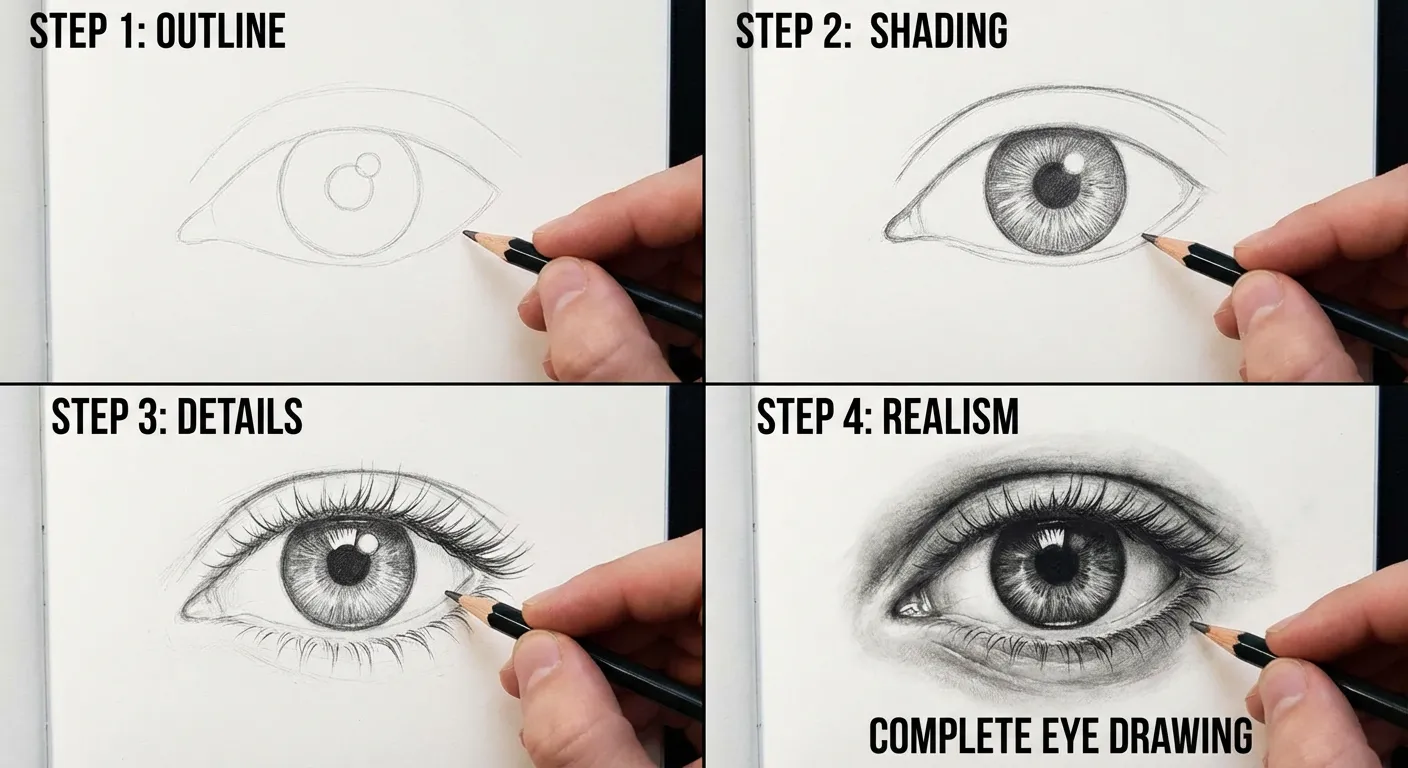
Introduction: Why Eye Drawing Is the Most Valuable Skill in Art
Eyes are the soul of every portrait. Whether you are following a beginner drawing lesson or refining years of sketching techniques, learning how to draw eyes is the single most transformative skill you can develop as an artist. A well-drawn eye communicates emotion, realism, and life — even on a blank page.
This comprehensive eye drawing guide covers everything from simple eye drawing steps for absolute beginners to advanced shading eyes tutorials, eye anatomy drawing, anime eye drawing tutorials, digital eye drawing techniques, and the nuanced differences between how to draw female eyes and how to draw male eyes. Every keyword, every concept, every stage — covered in one place.
Part 1: Eye Anatomy Drawing — Know What You Are Drawing
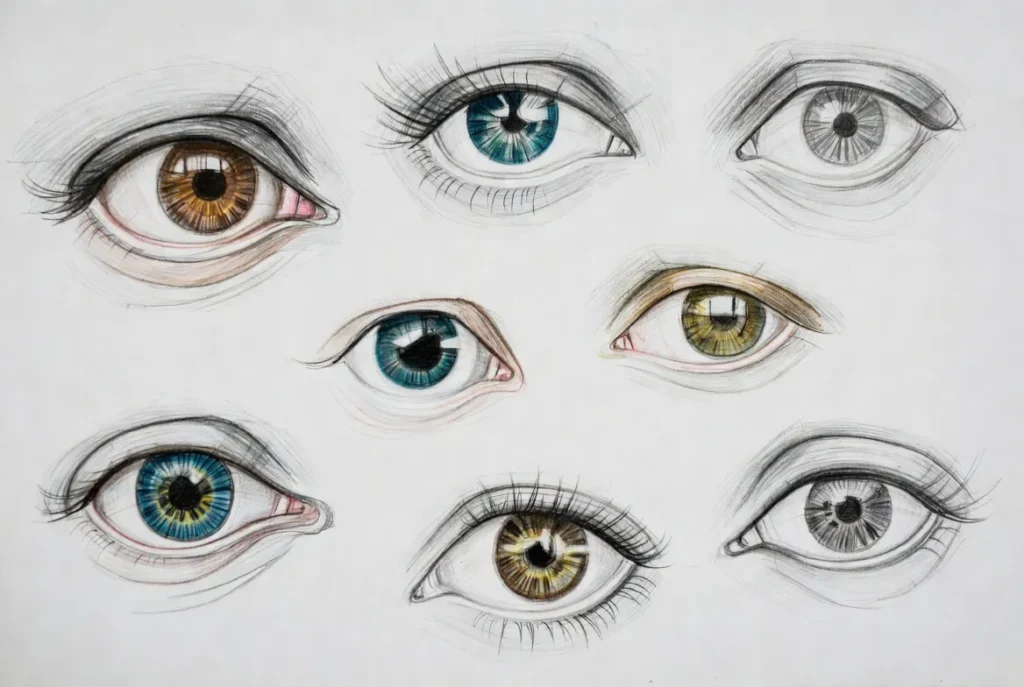
Before picking up a pencil, successful artists study what they are actually drawing. The human eye is a spherical organ nested inside a bony orbit, covered by two mobile eyelids. Understanding this three-dimensional reality is what transforms flat, lifeless sketches into convincing, realistic eye drawing.
The Key Parts of the Human Eye for Artists
The Iris is the colored ring surrounding the pupil. It contains radial fiber patterns that create texture, and it is bordered on its outer edge by a dark ring called the limbus. In eye drawing, the iris is drawn as a perfect circle — approximately 45–50% of the total eye width — with roughly one-quarter hidden behind the upper eyelid.
The Pupil is the dark circular opening at the center of the iris. It is darkest at its outer edges rather than uniformly black across its entire surface. The pupil sits very slightly above the true center of the iris and typically measures about one-third of the iris diameter in normal lighting conditions.
The Sclera is the white of the eye. In realistic eye drawing, the sclera is never pure white — it carries subtle off-white, gray, and pinkish tones, particularly near the inner and outer corners where blood vessels create warmth.
The Upper and Lower Eyelids have distinct characteristics. The upper lid is more mobile, curves more dramatically, and sits higher than most beginners expect. The lower lid is flatter and less mobile, with a lighter, less defined lash line.
The Lacrimal Caruncle is the small, pinkish-flesh nodule at the inner corner of the eye (the tear duct area). Including this detail in your how to draw human eyes practice is one of the fastest ways to add realism.
The Catchlight is the specular highlight — the tiny bright reflection of the light source visible on the surface of the cornea. This single detail is the most important element in making eyes look alive. Plan it before you shade anything, and protect it throughout the drawing process.
The Limbus is the dark ring at the outer edge of the iris where it meets the sclera. This ring gives the eye depth and a three-dimensional quality. Many beginners omit it; adding it will immediately elevate your drawing realistic eye details to a professional level.
Part 2: Eye Drawing Proportions — The Foundation of Accuracy
All great eye drawing guide content begins with proportions, because incorrect proportions are the number one cause of eyes that simply do not look right — regardless of how carefully the shading or detail work is executed.
Key Eye Drawing Proportions to Memorize
The width-to-height ratio of a human eye is approximately 3:1. An average eye is roughly three times as wide as it is tall at its highest point.
The iris size spans about 45–50% of the total eye width and about 90% of the total eye height (with the upper lid covering roughly the top 25% of the iris and the lower lid just grazing the bottom edge).
The inter-eye distance in a front-facing portrait equals approximately one eye-width. This means you could fit a third eye between the two eyes and it would be the same size as each existing eye.
The upper lid curve peaks slightly to the outer side of center, while the lower lid curve reaches its lowest point slightly toward the inner side of center. This creates the subtle, natural asymmetry of the almond shape.
The inner corner (tear duct) sits lower than the outer corner in most people, giving the eye a gentle upward angle from inner to outer corner.
Part 3: How to Draw Eyes Step by Step — The Complete Process
This is the core of any drawing eyes tutorial: a reproducible, step-by-step method you can apply to any eye, any style, any reference.
Step 1 — Lay Down Proportion Guidelines
Using a light H or 2H pencil, draw a horizontal line for the eye axis and a vertical line through the center of where the iris will sit. Mark the inner corner, outer corner, top of the iris, and bottom of the iris. These four points define everything that follows. This is your simple eye drawing steps foundation — do not skip it.
Pro Tip: Use very light pressure at this stage. Guidelines should be nearly invisible — they will be erased or buried under later shading.
Step 2 — Sketch the Eyelid Contours
Draw the upper lid as a gently arching curve that peaks slightly outside of center. Draw the lower lid as a much shallower curve that dips slightly inside of center. The inner corner is rounder and lower; the outer corner is sharper and higher. At this stage, you are just establishing the almond silhouette — do not add any detail yet.
Pro Tip: The upper lid is never a perfect symmetrical arch. It rises more steeply from the inner corner and descends more gradually toward the outer corner.
Step 3 — Draw the Iris Circle
Using your center cross as a guide, draw a perfect circle for the iris. A compass or circular template is helpful for beginners, as freehand circles often become ovals. Show approximately one-quarter of the iris hidden behind the upper lid, and let the very bottom of the iris just graze or slightly overlap the lower lid. This partial coverage is essential — a fully visible iris looks startled or unnatural.
Step 4 — Add the Pupil and Mark the Catchlight
Draw the pupil as a circle centered inside the iris, positioned very slightly above the iris’s true center. Before filling in any dark values, clearly mark the position of the catchlight — a small, irregular oval that sits slightly off-center, overlapping both the iris and the pupil edge. Leave this area completely untouched throughout all subsequent shading stages.
Pro Tip: If you accidentally fill over the catchlight, use a kneaded eraser to lift the value back. Catching it early is always easier than recovering it later.
Step 5 — Draw the Eyelashes
Upper lashes grow from behind the upper lid margin, curve upward and outward, and are thicker at the root than the tip. Draw them in small groups of two to four lashes, varying their length and the degree of their curve. They fan outward — the inner lashes angle slightly inward, the central lashes point upward, and the outer lashes curve outward. Lower lashes are shorter, sparser, and angle gently downward. This drawing eyelashes tutorial approach — working in grouped strokes rather than individual uniform lines — is the key to natural-looking lashes.
Pro Tip: Apply medium pressure at the lash root and release gradually as you stroke outward. This creates the natural taper from thick root to fine tip that characterizes realistic eyelashes.
Step 6 — Shade the Iris
The iris is not a flat, uniform color. It is darkest at its top where the upper lid casts a shadow down across it, and lightest in its lower half where it receives direct light. Use radial hatching strokes — lines that radiate outward from the pupil like spokes of a wheel — to create the fibrous texture of the iris. Add the limbus ring (a circle of dark value at the outer edge of the iris) to create depth and three-dimensionality.
Step 7 — Fill the Pupil
Fill the pupil completely using your darkest pencil (6B or 8B). The absolute darkest value in any realistic eye drawing is at the outer edge of the pupil where it meets the iris — not at the pupil’s center. This subtle gradient makes the pupil look like a deep opening rather than a flat disc.
Step 8 — Shade the Sclera and Lids
The sclera receives light gray shading — never pure white. The area closest to the iris is slightly darker due to proximity to the colored tissue. The inner and outer corners carry the most warmth in tone. The upper lid, which wraps over the curved eyeball, casts a shadow down across the sclera just below the upper lash line. The fold of skin above the upper lid (the lid crease) is a key shadow zone for realism.
Step 9 — Refine and Add Final Details
Strengthen your darkest darks (deepest pupil edges, upper lash line, lid crease shadow). Lift your brightest lights with a kneaded eraser (catchlight, lower lid waterline, any iris highlights). Check proportions one final time against your reference. Stand back and assess the overall value range before calling the drawing complete.
Part 4: Easy Eye Drawing for Beginners — Where to Start
If you are brand new to drawing, the full nine-step process above may feel overwhelming. For drawing eyes for beginners, start with this simplified version and build up gradually.
Draw a simple almond shape. Inside it, draw a circle for the iris. Inside that, draw a smaller circle for the pupil. Add a small dot for the catchlight. Draw five or six curved lines above the upper lid for lashes. That is your first complete eye. Practice this minimal version twenty or thirty times until the proportions feel natural in your hand before adding any complexity.
The most important creative drawing tips for beginners: draw slowly, erase without guilt, use references always, and measure constantly by comparing one element to another. Proportion accuracy is built through observation, not talent.
Part 5: How to Draw Realistic Eyes — The Shading Secrets
Realistic eye drawing lives and dies in the shading. The following eye shading techniques will take your drawings from flat and illustrative to dimensional and convincing.
The Seven Value Zones of the Eye
Understanding how to distribute values across an eye is the core of any shading eyes tutorial.
The pupil edges carry your absolute darkest value — nearly black. The upper iris in shadow (cast by the upper lid) is very dark, approaching but not quite reaching the pupil’s darkness. The average iris body sits at a mid-dark value. The lower iris in light is a lighter mid-tone. The shadowed sclera (especially near the upper lid) is a cool light gray. The average sclera is a warm off-white. The catchlight is pure, untouched paper white.
Essential Pencil Grades for Eye Drawing
Use H or 2H for construction lines and the lightest sclera shading. HB or B for mid-tone values in the sclera and lower iris. 2B and 4B for the iris body, eyelash roots, and lid lines. 6B and 8B for the deepest pupil darks and heaviest upper lid shadows. A white charcoal pencil or a hard vinyl eraser can lift highlights and add the glow to the waterline of the lower lid.
Key Shading Techniques
Hatching uses parallel pencil strokes to build tone gradually. Use it for the fibrous texture of the iris.
Circular blending with a blending stump creates smooth, seamless gradients perfect for the sclera.
Feathering uses light, flicking strokes that fade from dark to light, ideal for the gradual value change across the iris.
Burnishing uses heavy pressure with a light pencil or the smooth back of an eraser to push pigment into the paper, creating the maximum luminosity for highlights.
Negative drawing means using an eraser as a drawing tool — lifting lines of light back out of built-up shading — for waterline highlights and catchlight refinement.
Part 6: How to Draw Female Eyes vs. Male Eyes
The structural differences between how to draw female eyes and how to draw male eyes are subtle but significant. Getting these details right ensures your portraits read as the intended gender without relying on exaggerated caricature.
How to Draw Female Eyes
Female eyes in drawing typically feature a more dramatic, higher-arching upper lid curve. The outer corner often carries a slight upward lift. The lash line is thicker, more defined, and frequently shows a subtle outward flick at the outer corner suggesting liner. The upper lashes are longer, denser, and more dramatically curved. The brow is more arched, sits higher above the eye, and is more precisely defined in shape. The overall visible iris area tends to be slightly larger relative to the lid aperture, creating a more open, expressive appearance.
How to Draw Male Eyes
Male eyes in drawing typically feature a straighter, heavier upper lid curve that sits lower, closer to the iris. The brow is heavier, straighter, positioned lower above the eye, and has a less defined outer arch. The lashes are shorter and sparser, with less dramatic curl. The upper lid fold and the skin texture above the lid crease is more prominent and often receives more detailed shading. The overall eye aperture tends to be slightly narrower, giving a more focused or narrowed appearance.
Part 7: Anime Eye Drawing Tutorial — Stylized Eyes Explained
The anime eye drawing tutorial approach departs intentionally and dramatically from realistic proportions, but it is grounded in its own internal logic that, once understood, makes anime and manga eyes perfectly consistent and expressive.
Key Differences in Anime Eye Drawing
The iris in anime eyes typically fills 60–80% of the total eye height, compared to 45–50% in realistic drawing. This oversized iris is the defining visual characteristic of the style. The sclera shows very little above the iris and only slightly on the sides. The pupil is large and rounded, often with a slight vertical elongation. Multiple catchlights — a primary large highlight and several smaller secondary ones — replace the single realistic catchlight, giving anime eyes their characteristic sparkle. The upper lid line is thick, bold, and often has dramatic outer corner extensions. The lower lid is frequently just a simple curved line with minimal shading, keeping the focus on the upper half of the eye.
How to Draw Anime Eyes Step by Step
Begin with the upper lid as a heavy, bold curve. Drop a nearly vertical line from each end to form the outer and inner corner walls. Draw the bottom of the eye as a gentle curve connecting these walls. Fill the eye interior with a large iris circle (leaving very little sclera visible at top). Add a large pupil with a subtle vertical elongation. Mark and protect multiple catchlight areas before shading. Fill with flat base color, then add gradient shading from the top down. Finally, add detailed catchlights and a dark limbus ring.
Part 8: Side View Eye Drawing — Drawing Eyes in Profile
Side view eye drawing requires a fundamental rethinking of the eye’s shape, because the three-dimensional spherical form becomes directly apparent in profile.
From the side, the eye no longer reads as an almond. Instead, it reads as a triangular form with the apex pointing toward the nose. The upper lid protrudes forward significantly over the eyeball — from the side, the upper lid edge extends beyond the iris and pupil. The iris, which is a perfect circle from the front, appears as a narrow vertical ellipse from the side. The eyelashes, which fan outward from the front, now point generally forward and slightly upward. The lower lid angles back toward the face from the corner of the eye. These structural realities, once understood, make side view eye drawing straightforward.
Part 9: How to Draw Eyes Front View — Symmetry and Accuracy
Drawing eyes front view successfully depends on three skills: accurate proportions, consistent symmetry, and disciplined use of guidelines.
When drawing a pair of eyes in front view, always establish the eye line first — a single horizontal line across the full width of both eyes. Mark the five equal sections of this line: left outer corner, left inner corner, the inter-eye space, right inner corner, right outer corner. This five-part division (each section approximately equal) is the foundational eye drawing proportions rule for facial construction. Build both eyes simultaneously rather than completing one before starting the other — this is the most reliable way to maintain symmetry through every stage.
Part 10: Digital Eye Drawing Tutorial — Working in Software
Digital eye drawing follows identical foundational principles — proportions, anatomy, value, shading — but the workflow and tools differ from traditional pencil drawing.
Digital Eye Drawing Workflow
Begin on a sketch layer set to low opacity. Establish proportions and the basic almond shape. On a new layer beneath, block in the flat base color of the iris. On a multiply-blend layer above the iris color, build your shading gradients — darkest at the top where the lid shadow falls, lighter in the lower iris. Use a soft airbrush for broad, smooth value transitions and switch to a hard round brush for sharp details: the pupil edge, the lash line, the limbus ring, the precise catchlight shape. Add eyelashes on their own separate layer, which allows you to adjust their opacity, curve, and thickness independently.
The greatest advantage of digital eye drawing is non-destructive editing — you can adjust values, shift hues, and experiment with different iris colors without damaging any previous work. Use this advantage actively, not just as a safety net.
Part 11: Drawing Practice Tips to Improve Drawing Skills
Consistent, deliberate drawing practice is the only genuine path to improvement. The following art learning guide and drawing practice tips will accelerate your progress significantly.
Practice daily, even briefly. Twenty minutes of focused eye drawing daily outperforms a three-hour weekend session. Frequency builds muscle memory; duration alone does not.
Use strong references. Do not draw from imagination until you can accurately draw from reference. Collect high-quality photographic references of eyes in different lighting conditions, from different angles, and of different ages and ethnicities. Your drawing practice tips should always include reference use.
Alternate between copying and memory drawing. Spend one session copying from reference as accurately as possible. Spend the next session drawing an eye from memory without any reference. This alternation accelerates retention dramatically.
Analyze before you draw. Before making a single mark, spend two minutes silently studying your reference. Where are the darkest darks? Where are the lightest lights? What is the exact shape of the catchlight? How much of the iris is covered by the upper lid? This pre-drawing analysis is one of the most valuable sketching techniques beginners almost never practice.
Date every drawing. Keep all your practice sheets and date them. Reviewing your progress after 30 or 60 days of consistent art tutorials for beginners study is one of the most motivating experiences available to a developing artist.
Study master drawings. Study how great artists — Dürer, Sargent, Holbein, Mucha — drew eyes. Notice what they emphasized, what they simplified, and what they left out entirely. This is an irreplaceable art learning guide that no tutorial can fully replace.
Part 12: Beginner Drawing Lessons — Common Eye Drawing Mistakes and Fixes
Understanding the most common mistakes in how to draw eyes easy and how to correct them will save you enormous frustration in your drawing practice.
Mistake: Making the eye too round. Fix: Remember the 3:1 width-to-height ratio. Measure the width you have drawn and compare it to the height. The eye is always wider than it is tall.
Mistake: Drawing uniform eyelashes. Fix: Vary the length, spacing, and angle of every lash. Group them in clusters of two to four. Real lashes overlap and vary dramatically.
Mistake: Making the sclera pure white. Fix: Add a very light gray value across the entire sclera, with slightly darker gray near the upper lid shadow. This immediately increases realism.
Mistake: Forgetting the upper lid shadow on the iris. Fix: The upper lid casts a distinct shadow down across the top of the iris. This shadow zone should be noticeably darker than the rest of the iris and creates the single biggest shift toward realism.
Mistake: Placing the catchlight as a perfect centered circle. Fix: The catchlight is irregular, slightly off-center, and often overlaps the border between the iris and the pupil. It is a reflection of the light source — its shape mirrors the shape of that source.
Mistake: Making both eyes identical. Fix: Even in symmetrical faces, the two eyes are never perfectly identical. Slight variations in size, angle, and eyelid shape are natural and should be preserved rather than corrected away.
Conclusion: Your Eye Drawing Learning Path
Learning how to draw eyes is a journey measured in months of consistent drawing practice rather than a destination reached in a single tutorial. This eye drawing guide has given you every concept you need — from eye drawing proportions and eye anatomy drawing to realistic eye drawing shading techniques, anime eye drawing tutorials, how to draw female eyes versus male eyes, side view eye drawing, and digital eye drawing workflow.
Return to this guide regularly. The concepts you skip over as a beginner — like the limbus ring or the upper lid cast shadow — will suddenly click into place once your foundational skills have developed enough to receive them. That is the nature of art learning: every revisit reveals something new.
Pick up your pencil today. Draw one eye from reference. Date it. Save it. You will be grateful you did when you compare it to where you are six months from now.











Leave a Reply