

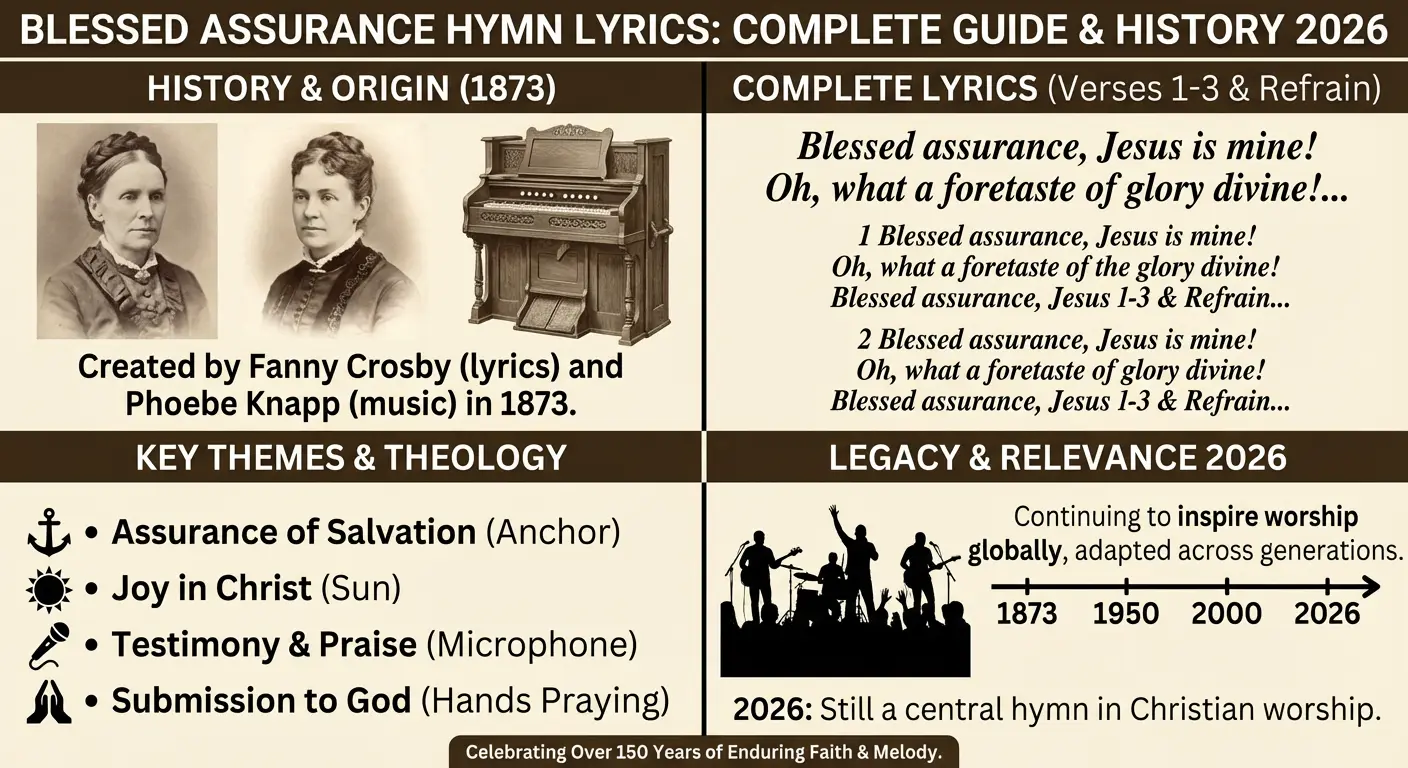
The blessed assurance hymnal lyrics have touched hearts and strengthened faith for over 150 years, making this hymn one of Christianity’s most cherished worship songs. Written by blind hymn writer Fanny Crosby in 1873, “Blessed Assurance” represents the pinnacle of American gospel hymnody, combining profound theological truth with deeply personal testimony of salvation and grace.
This comprehensive guide explores every aspect of this timeless hymn, from its complete lyrics and historical context to its theological significance and enduring impact on Christian worship. Whether you’re a worship leader, music historian, or simply someone who finds comfort in these sacred words, this exploration of blessed assurance hymnal lyrics will deepen your appreciation for one of faith’s most powerful musical expressions.
Complete Blessed Assurance Hymnal Lyrics
Verse 1
Blessed assurance, Jesus is mine! O what a foretaste of glory divine! Heir of salvation, purchase of God, Born of His Spirit, washed in His blood.
Refrain: This is my story, this is my song, Praising my Savior all the day long; This is my story, this is my song, Praising my Savior all the day long.
Verse 2
Perfect submission, perfect delight, Visions of rapture now burst on my sight; Angels descending bring from above Echoes of mercy, whispers of love.
Refrain: This is my story, this is my song, Praising my Savior all the day long; This is my story, this is my song, Praising my Savior all the day long.
Verse 3
Perfect submission, all is at rest I in my Savior am happy and blest, Watching and waiting, looking above, Filled with His goodness, lost in His love.
Refrain: This is my story, this is my song, Praising my Savior all the day long; This is my story, this is my song, Praising my Savior all the day long.
The Story Behind Blessed Assurance
The creation of blessed assurance hymnal lyrics represents one of the most remarkable collaborations in Christian music history. In 1873, Phoebe Knapp, a wealthy philanthropist and amateur composer, visited her dear friend Fanny Crosby at her home in Brooklyn, New York. Knapp had composed a beautiful melody and wanted Crosby’s opinion on it.
As Knapp played the tune on her piano, something extraordinary happened. Before the music finished, Fanny Crosby—who had been blind since infancy—exclaimed, “Why, that says, ‘Blessed assurance, Jesus is mine!'” Within minutes, the complete hymn text flowed from Crosby’s heart and mind, as if the words had been waiting for that precise musical moment to be released.
This spontaneous creation reflects Crosby’s incredible gift for hymn writing. Throughout her 95-year life, she penned over 8,000 hymns, but blessed assurance hymnal lyrics remain among her most personal and powerful. The hymn wasn’t merely a professional composition—it was her testimony, her declaration of faith, and her personal assurance of salvation through Jesus Christ.
Fanny Crosby: The Blind Poetess
Frances Jane Crosby, known affectionately as Fanny, lost her sight at six weeks old due to improper medical treatment. Rather than allowing blindness to limit her, Crosby developed an extraordinary memory and poetic ability. She memorized entire books of the Bible and composed verses mentally before dictating them to others.
Her personal relationship with Christ deeply influenced every hymn she wrote. The blessed assurance hymnal lyrics weren’t theoretical theology—they expressed her lived experience of God’s grace. Crosby often said that her blindness was a gift, allowing her to see spiritual truths more clearly than physical sight ever could.
Theological Significance of Blessed Assurance Hymnal Lyrics
The blessed assurance hymnal lyrics contain profound theological concepts woven seamlessly into poetic expression. Each phrase carries layers of biblical meaning that have made this hymn a teaching tool as much as a worship song.
Assurance of Salvation
The opening declaration—”Blessed assurance, Jesus is mine”—establishes the hymn’s central theme: the certainty of salvation through personal relationship with Christ. This assurance isn’t presumptuous confidence but biblical faith rooted in God’s promises. The concept directly reflects passages like 1 John 5:13: “I write these things to you who believe in the name of the Son of God that you may know that you have eternal life.”
Christian theology distinguishes between hoping for salvation and having assurance of it. Fanny Crosby’s words affirm that believers can know with certainty they belong to Christ. This theological position, sometimes called “eternal security” or “perseverance of the saints,” has been central to Protestant Christianity since the Reformation.
Foretaste of Glory
The phrase “O what a foretaste of glory divine” introduces the concept of present joy anticipating future fulfillment. Christian believers experience glimpses of heaven’s glory even while living on earth. This theological idea, known as “inaugurated eschatology,” suggests that eternal life begins at salvation, not merely after physical death.
The blessed assurance hymnal lyrics beautifully capture this tension between “already and not yet”—we possess salvation now, yet await its complete manifestation in eternity. Every worship experience, every moment of communion with God, every answer to prayer serves as a foretaste of the unhindered relationship believers will enjoy in heaven.
Purchased Redemption
“Heir of salvation, purchase of God” reflects the biblical doctrine of redemption. The term “purchase” refers to Christ’s atoning work on the cross, where He paid the price for human sin. This concept appears throughout Scripture, including 1 Corinthians 6:20: “You were bought with a price.”
As heirs of salvation, believers inherit eternal life not through their own merit but through God’s gracious gift. This inheritance theme runs throughout the New Testament, particularly in Romans 8:17, which describes believers as “heirs of God and fellow heirs with Christ.”
Spiritual Rebirth and Cleansing
“Born of His Spirit, washed in His blood” encapsulates two essential Christian doctrines: regeneration and justification. Being “born of His Spirit” references Jesus’s teaching to Nicodemus about being “born again” (John 3:3-7). This spiritual rebirth transforms a person’s nature, creating new life in Christ.
“Washed in His blood” speaks to cleansing from sin through Christ’s sacrificial death. This powerful imagery appears frequently in Scripture, including Revelation 1:5 and 1 John 1:7. The blessed assurance hymnal lyrics compress these profound theological truths into memorable, singable phrases that reinforce core Christian beliefs.
Musical Composition and Structure
Phoebe Palmer Knapp’s melody for blessed assurance hymnal lyrics perfectly complements Crosby’s text, creating an inseparable unity of words and music. The tune, officially titled ASSURANCE in hymnals, exhibits characteristics that have contributed to the hymn’s enduring popularity.
Melodic Analysis
The melody spans a comfortable vocal range, making it accessible to congregations of varying musical abilities. Its structure follows a classic AABA pattern in the verses, with the refrain providing contrast and emotional climax. The ascending melodic line on “This is my story, this is my song” creates natural emphasis on these personal testimony words.
Musical scholars note how the melody’s gentle contour matches the peaceful assurance expressed in the lyrics. Unlike more dramatic hymns that employ wide intervallic leaps, ASSURANCE moves primarily in stepwise motion, reflecting the calm confidence of faith rather than agitated striving.
Harmonic Progression
The hymn’s harmonic structure employs traditional tonal progressions that were standard in 19th-century American gospel music. The use of simple I-IV-V chord relationships creates a sense of resolution and stability—musical qualities that reinforce the textual theme of assurance and certainty.
This harmonic simplicity also made blessed assurance hymnal lyrics easily adaptable across different musical styles. From traditional church organ accompaniment to Southern gospel piano arrangements to contemporary worship band instrumentation, the underlying harmonic framework supports diverse interpretations while maintaining the hymn’s essential character.
Blessed Assurance in Christian Worship History
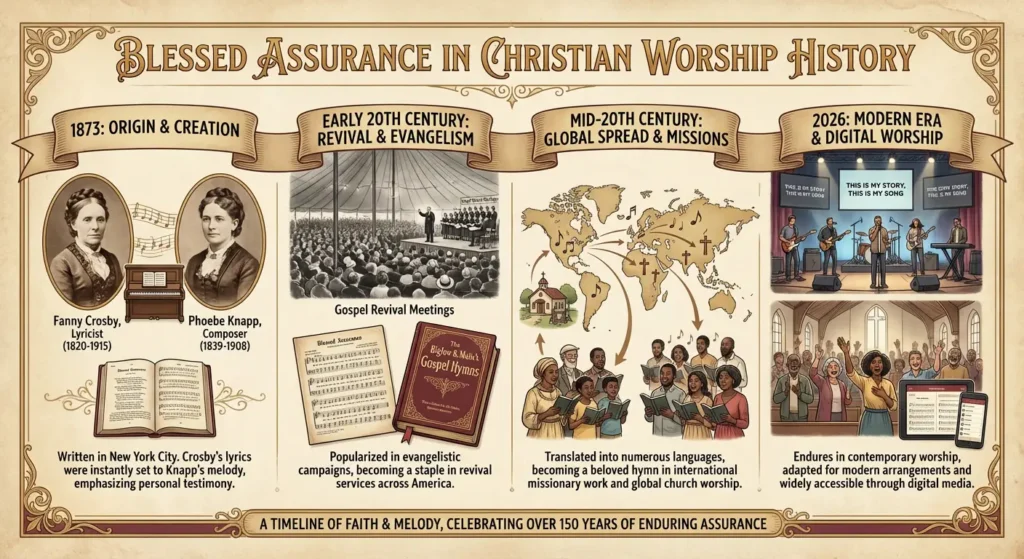
Since its publication in 1873, blessed assurance hymnal lyrics have maintained a prominent place in Christian worship across denominational lines. The hymn appears in virtually every major hymnal published in English-speaking countries, testifying to its universal appeal within Christianity.
Denominational Adoption
Methodist, Baptist, Presbyterian, Pentecostal, and non-denominational churches alike have embraced this hymn. Its appearance in the Methodist Hymnal holds special significance given Fanny Crosby’s Methodist background and the denomination’s emphasis on assurance of salvation—a doctrine John Wesley called “the witness of the Spirit.”
The hymn’s theological balance makes it acceptable across the Protestant spectrum. It affirms salvation by grace without downplaying human response (“perfect submission”), acknowledges present spiritual experience while maintaining future hope, and celebrates personal assurance without promoting presumption or pride.
Revival and Evangelistic Use
Blessed assurance hymnal lyrics became a staple of 19th and 20th-century revival meetings and evangelistic campaigns. Evangelists like Dwight L. Moody and Billy Sunday frequently incorporated the hymn into their services. Its clear presentation of salvation truths and memorable refrain made it effective for communicating the gospel message to diverse audiences.
The personal testimony aspect of the refrain—”This is my story, this is my song”—invited individuals to make the hymn’s affirmations their own. Countless believers have reported that singing blessed assurance hymnal lyrics helped crystallize their understanding of salvation and strengthen their faith during seasons of doubt or difficulty.
Verse-by-Verse Analysis
Verse One: The Foundation of Faith
The opening verse establishes the hymn’s doctrinal foundation. Each line builds upon the previous one, creating a logical progression from personal assurance through theological truth to experiential reality.
“Blessed assurance, Jesus is mine” places relationship at the center. Christianity isn’t merely intellectual assent to doctrines but personal connection with Christ. The possessive “mine” reflects biblical language where Christ speaks of “my sheep” and believers speak of “my Lord and my God.”
“O what a foretaste of glory divine” shifts from present possession to future hope. The exclamation “O what” expresses wonder and amazement—appropriate responses to God’s grace. Glory, in biblical usage, refers to God’s manifest presence and perfection, which believers will experience fully in eternity.
The theological terms “heir of salvation” and “purchase of God” ground personal experience in objective truth. Believers possess assurance not because of subjective feelings but because of God’s completed work in Christ. This balance between experience and truth characterizes mature Christian faith.
“Born of His Spirit, washed in His blood” concludes the verse with transformation imagery. These aren’t metaphorical descriptions but spiritual realities that define Christian identity. The blessed assurance hymnal lyrics present salvation as radical change, not moral improvement.
Verse Two: Submission and Vision
The second verse explores the internal experience of grace, focusing on surrender and spiritual perception. “Perfect submission, perfect delight” presents a paradox understood by mature believers—true joy comes through yielding to God’s will, not asserting personal autonomy.
This concept challenges contemporary culture’s emphasis on self-determination and personal fulfillment through independence. The blessed assurance hymnal lyrics suggest that perfect delight results from perfect submission—a counterintuitive truth that only those who’ve experienced it can fully appreciate.
“Visions of rapture now burst on my sight” uses dramatic language to describe spiritual insight. Despite Crosby’s physical blindness, her spiritual sight perceived glories invisible to natural eyes. “Rapture” here means overwhelming joy, not the eschatological event some Christians anticipate.
The angels descending with “echoes of mercy, whispers of love” creates an almost mystical atmosphere. Yet this isn’t escapist spirituality divorced from daily life—it’s the awareness of heaven’s reality breaking into earthly experience, strengthening believers for their earthly journey.
Verse Three: Rest and Readiness
The final verse balances rest with anticipation, present satisfaction with future expectation. “Perfect submission, all is at rest” returns to the submission theme but emphasizes its result—inner peace. Biblical rest (as in Hebrews 4) doesn’t mean inactivity but ceasing from self-effort and trusting God’s sufficiency.
“I in my Savior am happy and blest” makes explicit what the entire hymn implies—true happiness comes from being “in” Christ, a phrase Paul uses repeatedly to describe believers’ spiritual position. This prepositional phrase “in” indicates intimate union, not mere association.
“Watching and waiting, looking above” introduces eschatological awareness. Believers live in tension between present contentment and future hope, satisfied in Christ yet longing for His return. This “already but not yet” posture characterizes New Testament Christianity.
The concluding phrase “Filled with His goodness, lost in His love” brings the blessed assurance hymnal lyrics to their climax. Being “lost” in God’s love paradoxically means being truly found—losing selfish identity to discover true self in relationship with Christ.
Step-by-Step Guide to Using Blessed Assurance in Worship
Understand the Historical Context
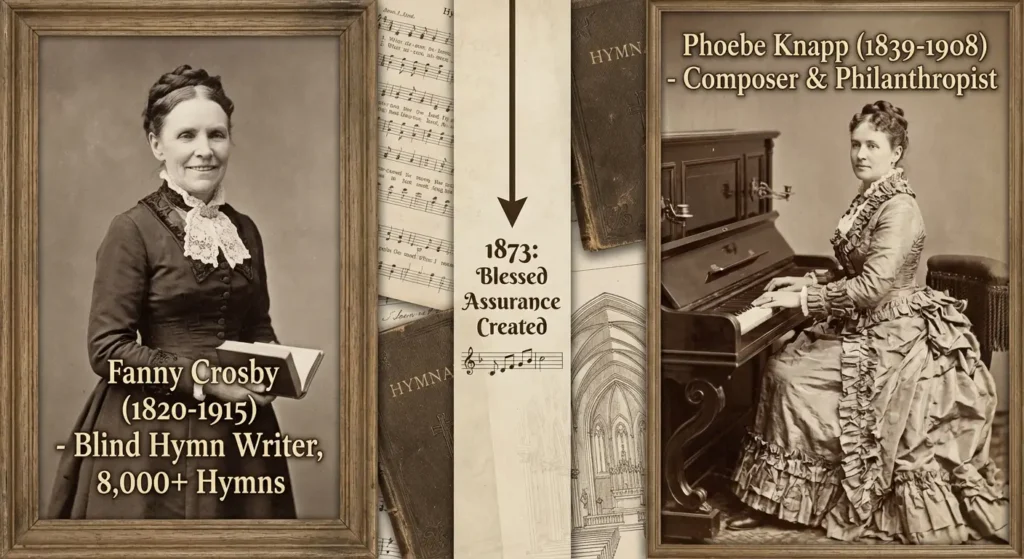
Split-screen historical image featuring authenticated photographs of Fanny Crosby (left) and Phoebe Knapp (right) from the 1870s era. Fanny Crosby’s portrait shows her characteristic warm smile and period dress, with text overlay identifying her as “Fanny Crosby (1820-1915) – Blind Hymn Writer, 8,000+ Hymns.” Phoebe Knapp’s portrait displays her elegant Victorian attire at a piano, labeled “Phoebe Knapp (1839-1908) – Composer & Philanthropist.” The center section includes a timeline graphic showing “1873: Blessed Assurance Created” with a small musical notation snippet of the opening bars. Background elements include faded images of original manuscript pages and period hymnals, providing historical context for worship leaders and historians studying the hymn’s origins.
Learn the Complete Lyrics and Melody
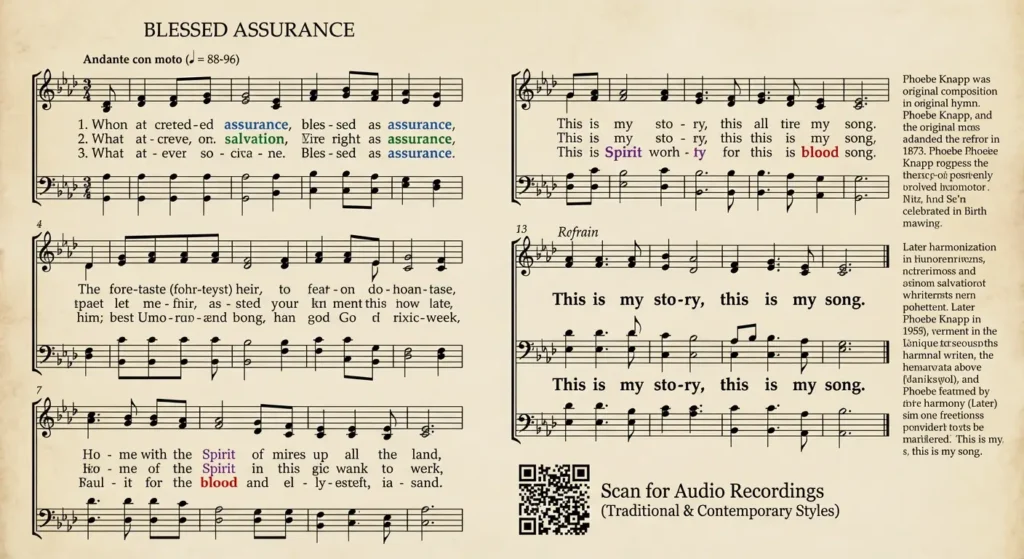
Full sheet music display of “Blessed Assurance” showing all three verses plus refrain in traditional hymnal format. The musical notation includes both treble and bass clefs with standard four-part harmony (SATB arrangement). Each verse of blessed assurance hymnal lyrics appears beneath the corresponding musical phrases, with phonetic pronunciation guides for archaic or difficult words. Color-coded annotations highlight key theological terms: “assurance” (blue), “salvation” (green), “Spirit” (purple), and “blood” (red). Tempo marking “Andante con moto” appears at the top with metronome marking (♩= 88-96). The refrain section features bold text emphasizing “This is my story, this is my song.” Margin notes provide historical context about Phoebe Knapp’s original composition and later harmonization variations. The bottom includes a QR code linking to audio recordings demonstrating traditional and contemporary performance styles.
Apply Theological Insights to Contemporary Worship
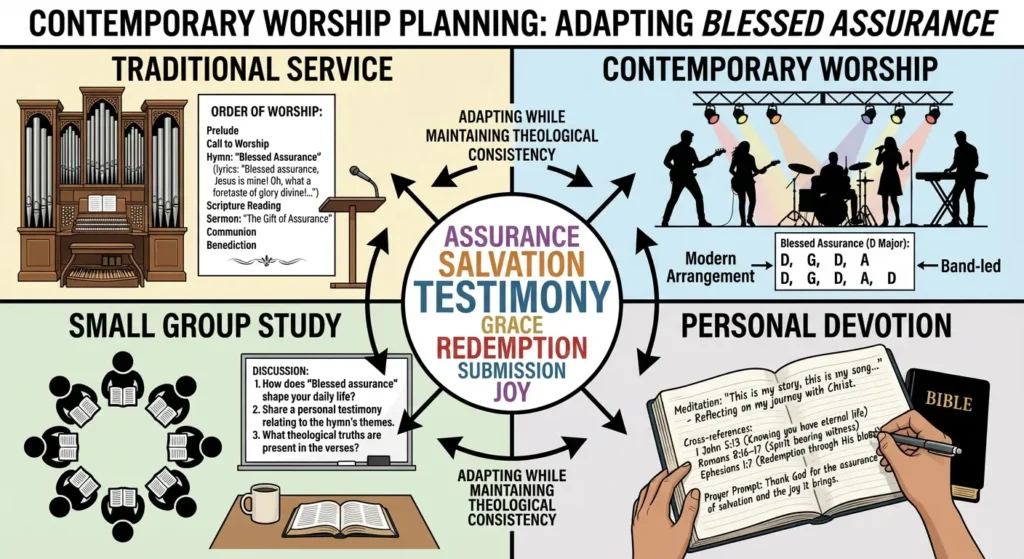
Contemporary worship planning infographic divided into four quadrants representing different service contexts. Top-left quadrant shows “Traditional Service” with organ imagery and bulletin snippet featuring blessed assurance hymnal lyrics scheduled between scripture reading and sermon. Top-right displays “Contemporary Worship” with worship band silhouettes and chord chart adaptation (D-G-A progression). Bottom-left presents “Small Group Study” with discussion questions about assurance doctrine and personal testimony themes from the hymn. Bottom-right illustrates “Personal Devotion” with journal pages, Bible verses cross-referenced with hymn phrases (1 John 5:13, Romans 8:16-17, Ephesians 1:7), and meditation prompts. Center circle contains a word cloud of key themes: assurance, salvation, testimony, grace, redemption, submission, joy. Arrows connect the quadrants showing how blessed assurance hymnal lyrics adapt across worship contexts while maintaining theological consistency.
Modern Interpretations and Recordings
Blessed assurance hymnal lyrics have been recorded hundreds of times by artists spanning multiple genres, from traditional sacred music to contemporary Christian, gospel, country, and even secular arrangements. Each interpretation brings new dimensions to Crosby’s timeless words.
Traditional Sacred Recordings
Classic recordings by church choirs and soloists preserve the hymn’s original character and devotional atmosphere. George Beverly Shea’s recordings with Billy Graham crusades introduced blessed assurance hymnal lyrics to millions worldwide. His straightforward, reverent interpretation became definitive for many believers.
The Mormon Tabernacle Choir’s arrangement showcases the hymn’s power when performed by large ensembles with full orchestration. Their recording demonstrates how blessed assurance hymnal lyrics translate effectively across Christian traditions, even those outside Protestant evangelicalism where the hymn originated.
Gospel and Contemporary Christian Versions
Gospel artists have created soul-stirring interpretations that emphasize the hymn’s personal testimony aspect. Artists like CeCe Winans and the Blind Boys of Alabama have recorded versions that highlight the emotional and experiential dimensions of assurance, connecting Crosby’s 19th-century testimony with contemporary African American worship traditions.
Contemporary Christian artists have updated the musical settings while preserving the lyrics’ integrity. Third Day, Casting Crowns, and other bands have introduced blessed assurance hymnal lyrics to younger generations through arrangements incorporating modern instrumentation and contemporary worship styles.
Country and Americana Adaptations
Country music artists have long embraced classic hymns, and blessed assurance hymnal lyrics appear frequently in this genre. Alan Jackson’s straightforward rendition in his “Precious Memories” collection reached mainstream country audiences, demonstrating the hymn’s crossover appeal beyond explicitly religious contexts.
The hymn’s themes of finding peace through faith and having assurance amidst life’s uncertainties resonate with country music’s traditional values and storytelling emphasis. Artists like Randy Travis and Alabama have included versions on gospel albums, maintaining the genre’s historic connection with sacred music.
Teaching Blessed Assurance to New Generations
Passing blessed assurance hymnal lyrics to younger believers requires intentional effort in an era when many churches emphasize contemporary worship exclusively. Worship leaders and Christian educators employ various strategies to maintain connection with this hymnal heritage.
Integration with Contemporary Worship
Progressive worship leaders blend classic hymns with contemporary songs, creating intergenerational worship experiences. Blessed assurance hymnal lyrics work well in medleys with modern songs sharing similar themes. Pairing it with contemporary songs about grace, assurance, or testimony creates thematic unity across musical styles.
Some churches alternate verses between traditional organ accompaniment and contemporary band arrangements, demonstrating the hymn’s adaptability. This approach helps younger worshippers appreciate both historical and modern expressions of faith.
Educational Approaches
Sunday schools and youth groups benefit from learning blessed assurance hymnal lyrics within historical and theological context. Rather than simply singing the hymn, teachers can share Fanny Crosby’s remarkable story, explain the theological concepts, and invite students to write their own testimonies inspired by “This is my story.”
Christian schools and home educators use blessed assurance hymnal lyrics as teaching tools for multiple subjects—music theory, American history, theology, and poetry analysis. This multidisciplinary approach helps students appreciate the hymn’s cultural and spiritual significance beyond its function as a worship song.
The Psychology of Assurance in Christian Faith
Blessed assurance hymnal lyrics address fundamental human needs for certainty, belonging, and hope—psychological dimensions that partly explain the hymn’s enduring appeal across cultural and temporal boundaries.
Cognitive Aspects of Faith Assurance
Psychologists studying religious experience note that cognitive certainty about one’s relationship with God correlates with various measures of psychological wellbeing. The repeated declaration “Jesus is mine” and “This is my story” functions cognitively to reinforce personal identity as a believer.
This isn’t psychological manipulation but recognition that human beings think in narratives and require coherent stories to make sense of existence. Blessed assurance hymnal lyrics provide a theologically sound narrative framework for understanding one’s life within God’s redemptive story.
Emotional Regulation Through Worship
Singing blessed assurance hymnal lyrics in corporate worship settings provides emotional regulation benefits. The repetitive refrain creates a meditative quality that can reduce anxiety and promote peace. Research in music therapy demonstrates that familiar melodies with positive associations activate neural pathways associated with comfort and security.
For believers experiencing doubt or difficulty, the hymn’s affirmations function as cognitive restructuring—replacing anxious thoughts with truthful statements about God’s faithfulness and salvation’s certainty. This isn’t denying real struggles but anchoring emotions to theological truth.
Social Identity and Belonging
The collective singing of blessed assurance hymnal lyrics reinforces believers’ sense of belonging to a faith community. When congregations sing “This is my story,” they simultaneously affirm individual testimony and corporate identity. Each person’s story becomes part of the larger story of God’s people throughout history.
This communal dimension addresses human needs for connection and shared meaning. Knowing that Christians across centuries and cultures have sung these same words creates transcendent solidarity that transcends denominational, cultural, and temporal boundaries.
Blessed Assurance in Cultural Context
Beyond its religious significance, blessed assurance hymnal lyrics occupy an important place in American cultural history, appearing in literature, film, and public life in ways that demonstrate its penetration beyond church walls.
Literary and Artistic References
American authors have referenced blessed assurance hymnal lyrics in novels and poetry to evoke religious atmosphere or character background. The hymn serves as cultural shorthand for Protestant Christianity, particularly its evangelical expressions and Southern traditions.
Visual artists have created works inspired by the hymn’s imagery and themes. Paintings depicting spiritual assurance, heavenly visions, or scenes of worship often title themselves using phrases from Crosby’s lyrics, demonstrating the hymn’s influence on artistic imagination.
Film and Television Usage
Blessed assurance hymnal lyrics appear in numerous films and television programs, usually signifying religious faith or rural/Southern cultural settings. Directors use the hymn to establish character backgrounds, create emotional atmosphere, or signal themes of redemption and grace.
The hymn’s appearance in popular media, even secular contexts, testifies to its recognition factor in American culture. Many who never attend church still recognize blessed assurance hymnal lyrics from cultural exposure, making it one of Christianity’s most widely known musical expressions.
Presidential and Public Occasions
Several U.S. presidents and public figures have cited blessed assurance hymnal lyrics or included the hymn in official occasions. Its themes of confidence in divine providence and hopeful assurance resonate with American civil religious sensibilities while maintaining specifically Christian content.
The hymn has been performed at state funerals, memorial services, and other solemn public gatherings where its message of eternal hope provides comfort transcending political or sectarian divisions.
Frequently Asked Questions
What is a blessed assurance hymnal lyrics?
Sacred song text written by Fanny Crosby in 1873.
Who wrote Blessed Assurance hymn lyrics?
Fanny Crosby wrote words; Phoebe Knapp composed the melody.
When was Blessed Assurance hymn written?
Written in 1873 during collaborative session between Crosby and Knapp.
Is Blessed Assurance in public domain?
Yes, copyright expired; freely available for religious and educational use.
What does Blessed Assurance mean spiritually?
Confident certainty of salvation and personal relationship with Jesus Christ.
How many verses does Blessed Assurance have?
Three verses plus repeating refrain sung after each verse.
What key is Blessed Assurance usually sung?
Traditionally D major, though adapted to various vocal ranges.
Why is Blessed Assurance so popular?
Combines profound theology with personal testimony and memorable melodic structure.
What denomination uses Blessed Assurance most?
Used across Protestant denominations, especially Methodist, Baptist, and evangelical churches.
Can Blessed Assurance be modernized for contemporary worship?
Yes, many contemporary arrangements exist while preserving original lyrics.
What Bible verses relate to Blessed Assurance?
1 John 5:13, Romans 8:16, Ephesians 1:7, John 3:16.
Is Blessed Assurance appropriate for funerals?
Yes, frequently sung at Christian funerals emphasizing eternal hope.
How do you teach Blessed Assurance to children?
Use simplified explanations, focus on assurance theme, include historical storytelling.
What tempo should Blessed Assurance be sung?
Moderately paced (88-96 BPM), allowing clear articulation of words.
Are there different versions of Blessed Assurance lyrics?
Minor variations exist, but Crosby’s original text remains standard.
Conclusion: The Enduring Legacy of Blessed Assurance
The blessed assurance hymnal lyrics continue resonating with believers worldwide because they address timeless spiritual truths through beautiful, singable poetry. Fanny Crosby’s gift for expressing profound theology in accessible language created a hymn that transcends its Victorian origins to speak across centuries and cultures.
What makes blessed assurance hymnal lyrics particularly powerful is their personal nature—”This is my story, this is my song”—inviting each singer to make the testimony their own. The hymn doesn’t present abstract doctrines but lived experience of grace, creating space for individual appropriation while maintaining theological substance.
As churches navigate tensions between traditional and contemporary worship, blessed assurance hymnal lyrics demonstrate that truly great hymns possess inherent adaptability. The same words Fanny Crosby spontaneously composed in 1873 work equally well accompanied by pipe organ or electric guitar, sung by formal choirs or casual worship teams.
Future generations will continue discovering blessed assurance hymnal lyrics and finding in them what countless believers have experienced—words that give voice to faith, strengthen assurance, and connect individual testimony with the great communion of saints throughout history. In a world of constant change and uncertainty, the confident declaration “Jesus is mine” provides an anchor for souls seeking solid ground.
May these blessed assurance hymnal lyrics continue inspiring worship, teaching truth, and giving voice to faith for generations to come. This is our story, this is our song—praising our Savior all the day long.









Leave a Reply