

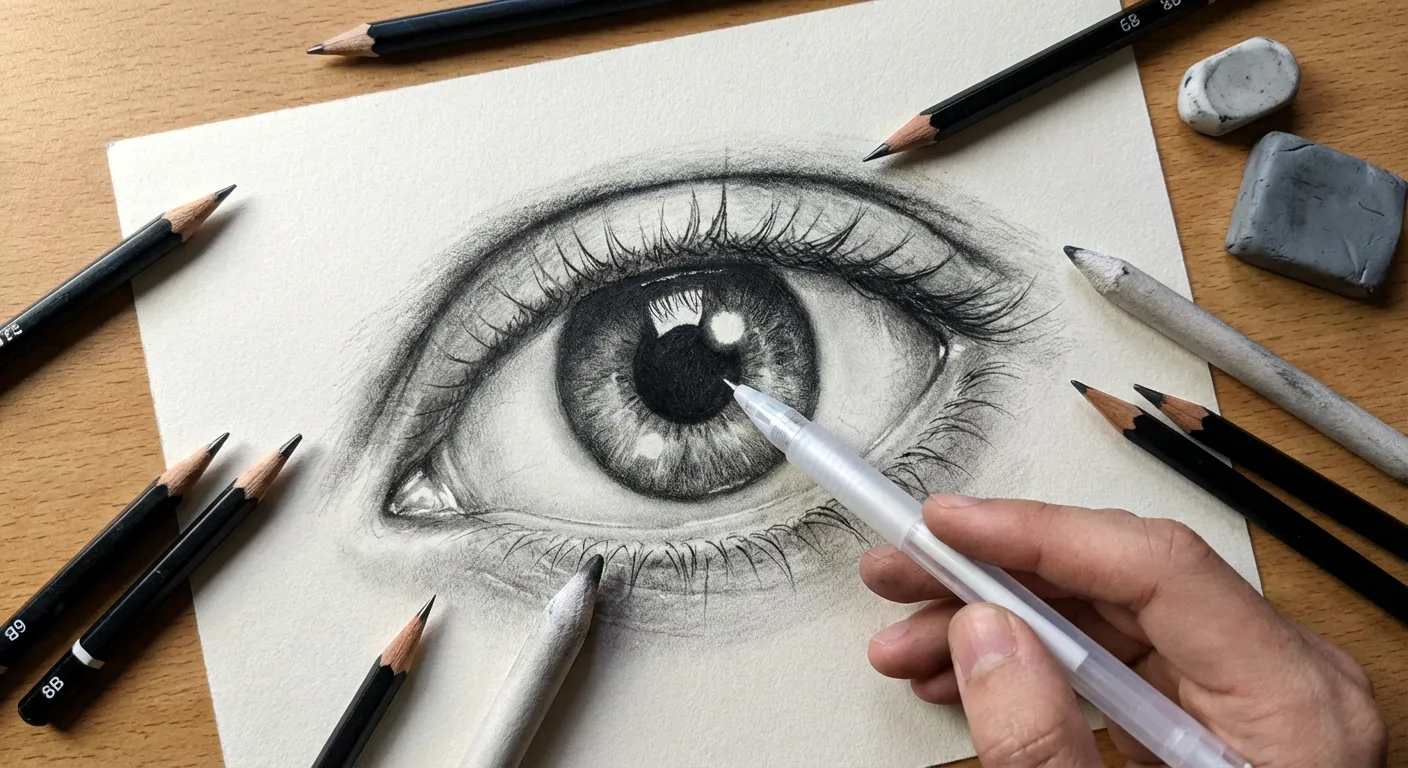
To add shine and depth to realistic pencil eyes in pencil drawing, you must do three things simultaneously: reserve or lift bright white highlights in the cornea and iris using a kneaded eraser or white gel pen; build rich, dark tonal values in the pupil and surrounding iris through layered graphite strokes (H to 8B range); and blend transitions smoothly between light and shadow using a blending stump or tortillon so the eye reads as a curved, three-dimensional, wet surface. The illusion of a glassy, living eye comes entirely from high contrast between deep shadows and sharp, clean highlights — and from understanding how light wraps around a sphere.
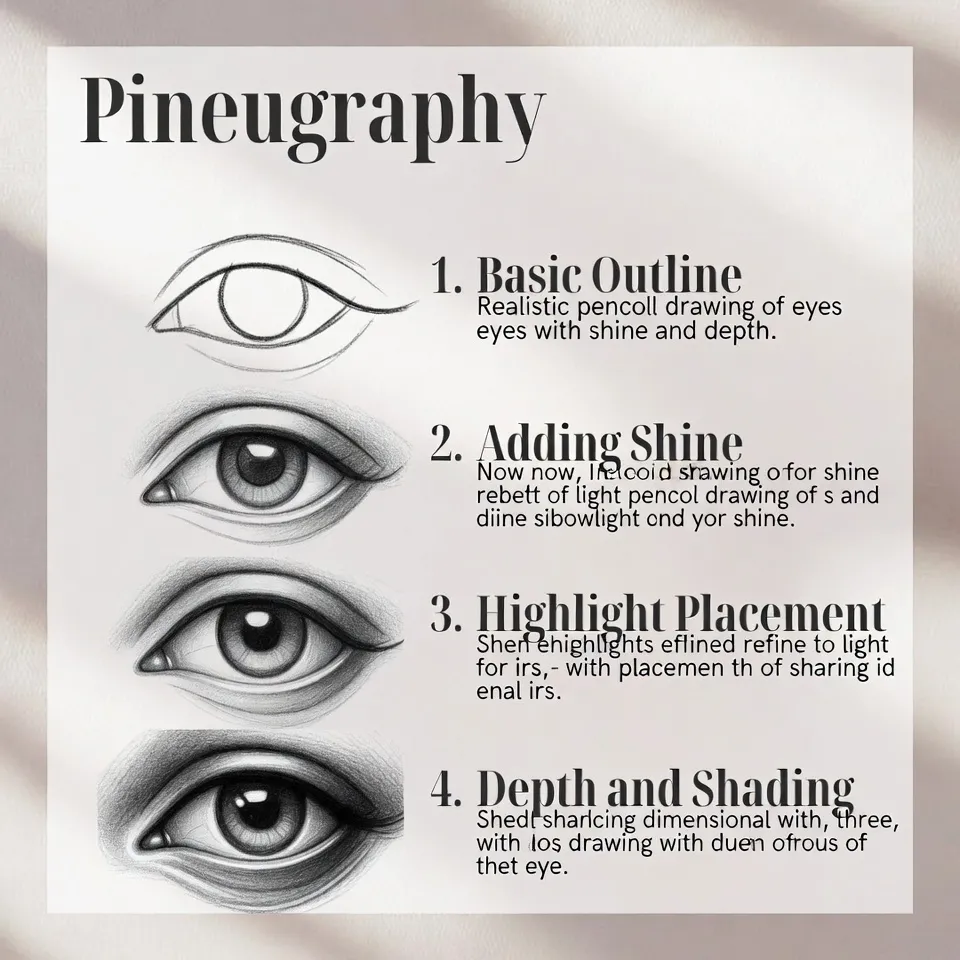
Why Pencil Eyes Look Flat — The Real Problem
Most beginner and intermediate artists make the same mistake: they shade the eye evenly. They cover the iris in uniform mid-tone grey, add a dark pupil on top, and call it done. The result always looks like a button sewn into a face — flat, stiff, and cartoon-like.
The real problem is a misunderstanding of what the eye actually is: a transparent, liquid-filled sphere sitting inside a bony socket, partially covered by thin, curved eyelids, constantly reflecting ambient light from multiple directions at once. It is one of the most optically complex objects in the human body.
Realistic pencil eye drawing in 2026 isn’t about drawing harder — it’s about drawing smarter. It means understanding tonal value, the hierarchy of light, and how graphite pencil grades interact with different paper textures to simulate depth, moisture, and translucency.
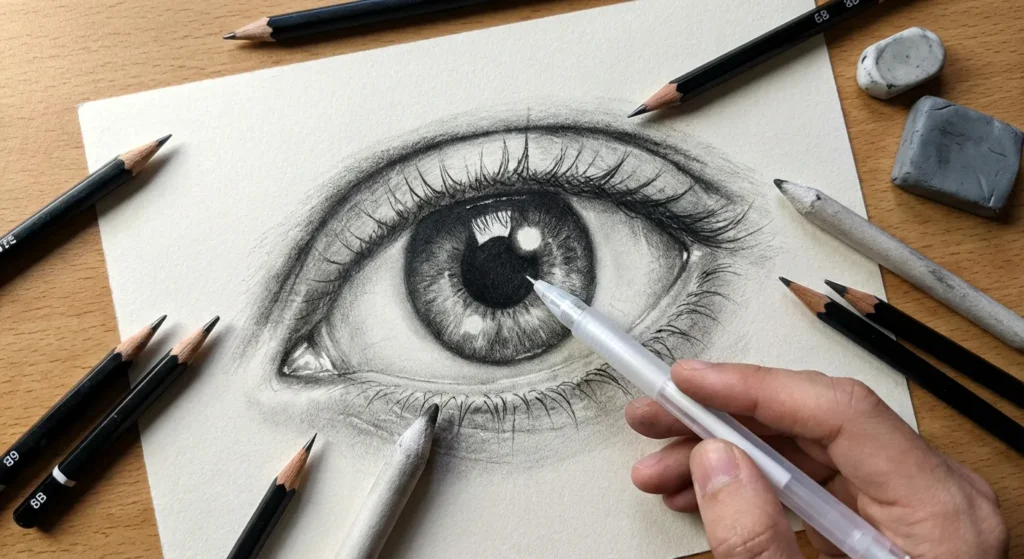
Once you understand the why, the how becomes obvious.
2. Understanding Eye Anatomy for Realistic Drawing
You cannot draw what you don’t understand. Before picking up your pencil, study these key structures:
The Cornea — The transparent dome covering the iris and pupil. This is where your brightest specular highlight lives. Light hits the cornea first, reflects sharply, and creates that iconic white dot or crescent shape that makes eyes look wet and alive.
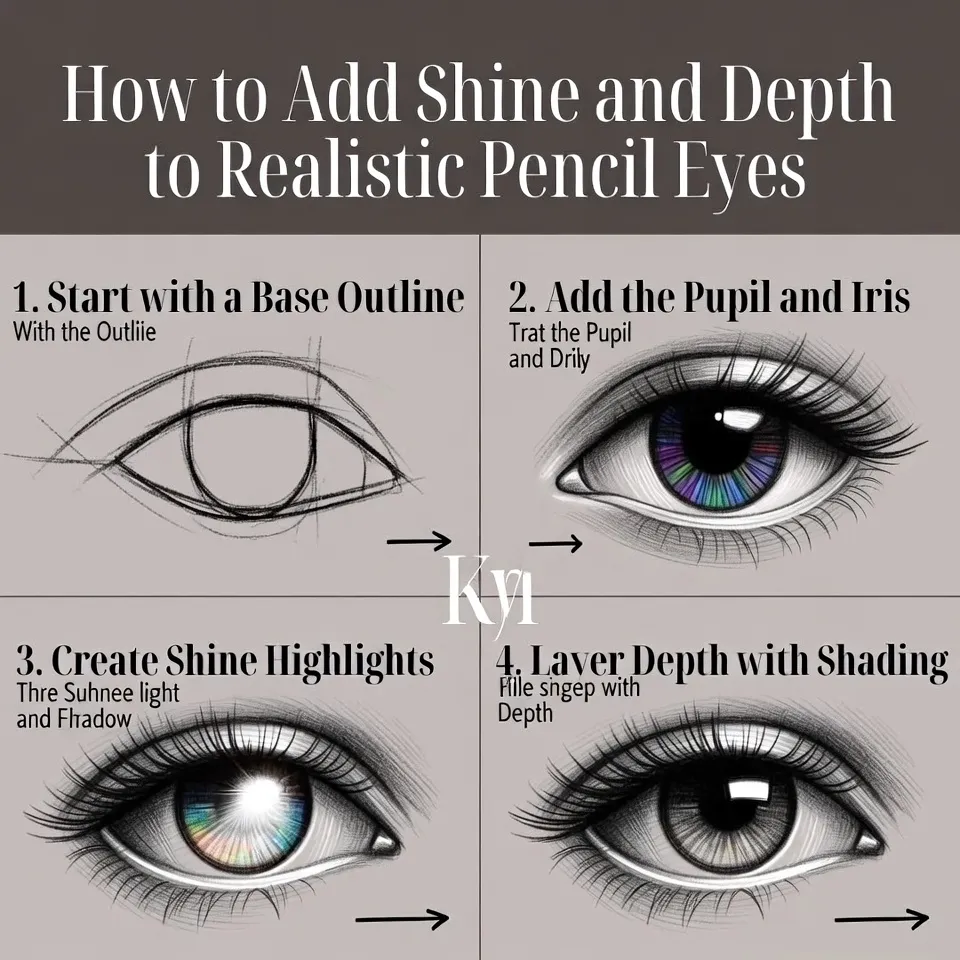
The Iris — The coloured ring surrounding the pupil. In real life it has complex radial fibres, crypts, and collarette patterns. In graphite, you simulate this with radiating lines, hatching, and careful value variation — darker near the pupil and near the outer ring, lighter in the middle zone.
The Pupil — A hole, not an object. It appears black because it absorbs almost all light. Your darkest graphite values (8B, 9B) go here. Even so, the pupil is rarely perfectly uniform — it often has a very subtle, dark reflected glow at its edges.
The Sclera — Commonly called the white of the eye. It is never pure white in a realistic drawing. It has veins, shadow areas from the eyelids, a slight warm or cool tint, and reflected colour from the iris. Leave some areas bright but always add subtle greys, especially near the corners and under the upper eyelid.
The Eyelids and Lash Line — The upper eyelid casts a strong shadow onto the top of the iris. This shadow is one of the most important depth cues in the entire drawing. Never skip it.
Tear Duct and Waterline — The inner corner (tear duct) and the inner rim of the eyelid (waterline) are often the most neglected parts of an eye drawing. Adding careful detail here — a small pink/light area in the tear duct, a thin light edge on the waterline — instantly adds realism.
3. Essential Materials for 2026 {#materials}
The art supply market in 2026 has expanded significantly, with more affordable professional-grade options than ever. Here is what you actually need:
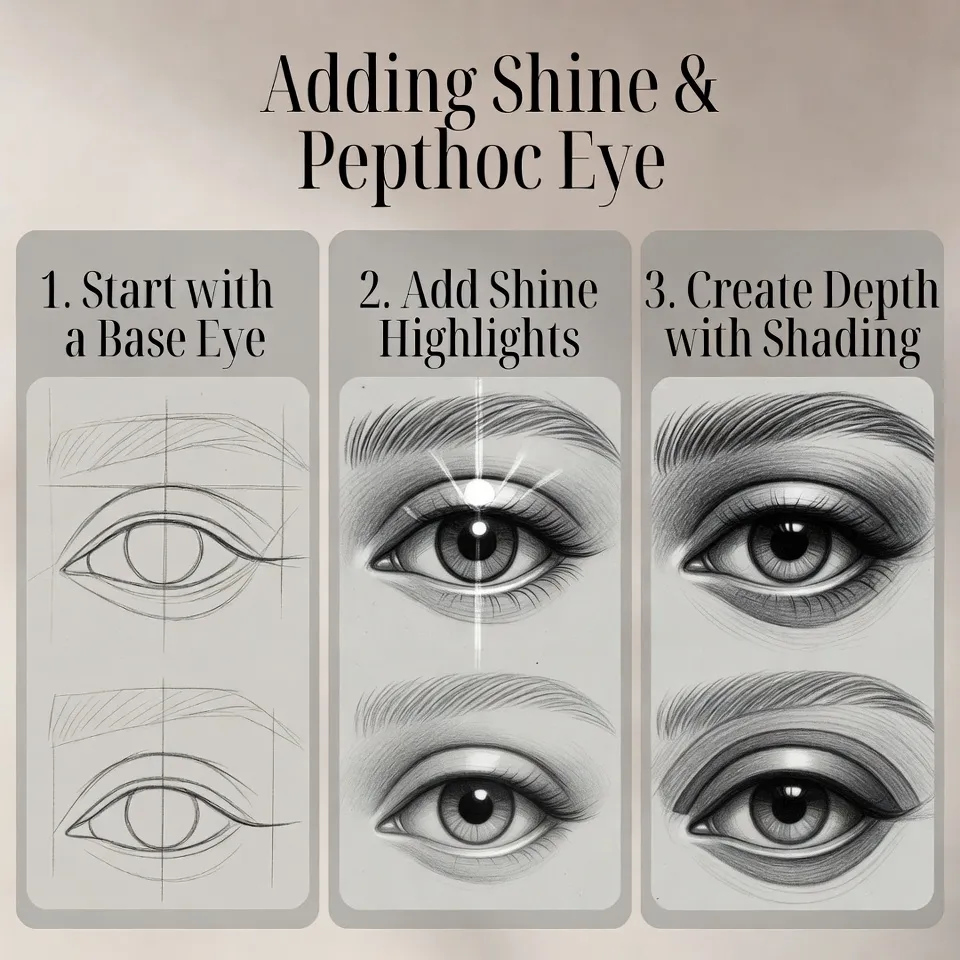
Graphite Pencils (Full Range) Use a full graphite pencil set ranging from 4H (very light, hard) to 8B or 9B (very dark, soft). For realistic eye drawing, the most used grades are: 2H (light base layers), HB (mid-tones), 2B–4B (iris darks and eyelash base), 6B–8B (pupil and deepest shadows).
Recommended brands in 2026: Staedtler Mars Lumograph, Faber-Castell 9000, Tombow Mono Drawing, Derwent Graphic.
Paper Use smooth or slightly textured drawing paper with at least 120gsm weight. Bristol board (smooth surface) is the gold standard for hyper-realistic pencil work because its tight tooth allows fine detail. For softer, more blended looks, use cartridge paper or Strathmore 400 series.
Blending Tools Tortillons (rolled paper stumps), blending stumps in multiple sizes (small for iris detail, large for skin blending), and a soft clean brush for removing graphite dust without smearing.
Erasers A kneaded eraser for lifting graphite to create soft highlights, a Tombow Mono Zero or Pentel Clic eraser for crisp, sharp highlights, and a standard vinyl eraser for large corrections.
White Gel Pen (2026 Essential) The Uni-ball Signo UM-153 or Sakura Gelly Roll white gel pen has become a standard tool in realistic pencil portraiture as of 2025–2026. It allows you to add opaque white highlights on top of dark graphite — useful for the corneal specular highlight and the waterline.
Mechanical Pencil A 0.3mm or 0.5mm mechanical pencil with 2B or HB lead is useful for fine iris fibre details and eyelash drawing.
4. How Light Behaves on the Eye — The Science Behind Shine {#light-science}
Understanding why eyes shine requires a brief look at how light interacts with curved, reflective, and transparent surfaces.
Specular Highlights are the bright, sharp reflections of a light source on a glossy surface. On the eye, this appears as a bright dot or crescent on the cornea, usually positioned in the upper quadrant (because most light sources are above). This highlight is the single most important element of a shiny, realistic eye. Without it, the eye reads as dry and dead.
Diffuse Reflection is the scattered light that illuminates the iris. Because the iris is curved, light falls off gradually from the brightest edge to the darkest. The upper portion of the iris is usually darkest (shadowed by the eyelid), while the lower portion catches more ambient light.
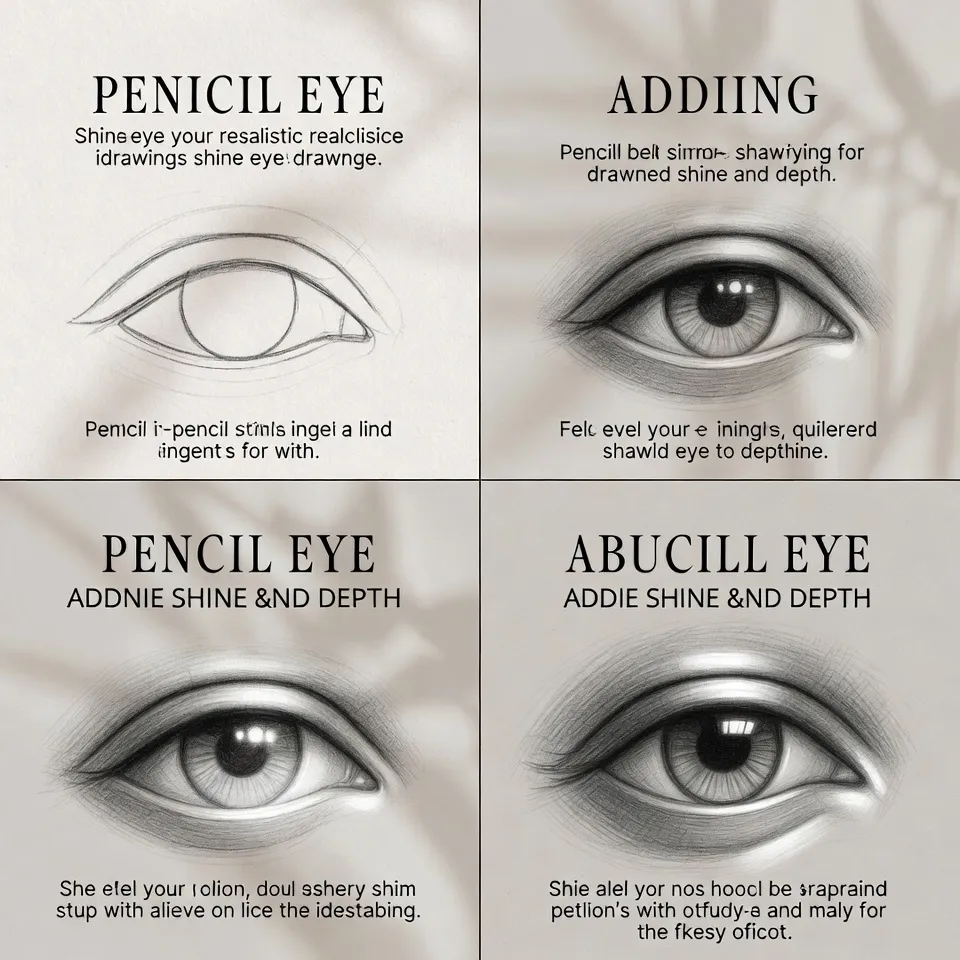
Transmitted Light is what makes coloured eyes glow from within. In graphite, you simulate this by keeping a lighter, almost mid-tone zone in the lower-middle iris, even when the rest of the iris is dark.
Ambient Occlusion refers to the soft, dark shadows that build up in creases, corners, and areas where surfaces meet. The corners of the eye, the fold where the eyelid meets the eye, and the lower lash line all have ambient occlusion shadows. These add tremendous depth.
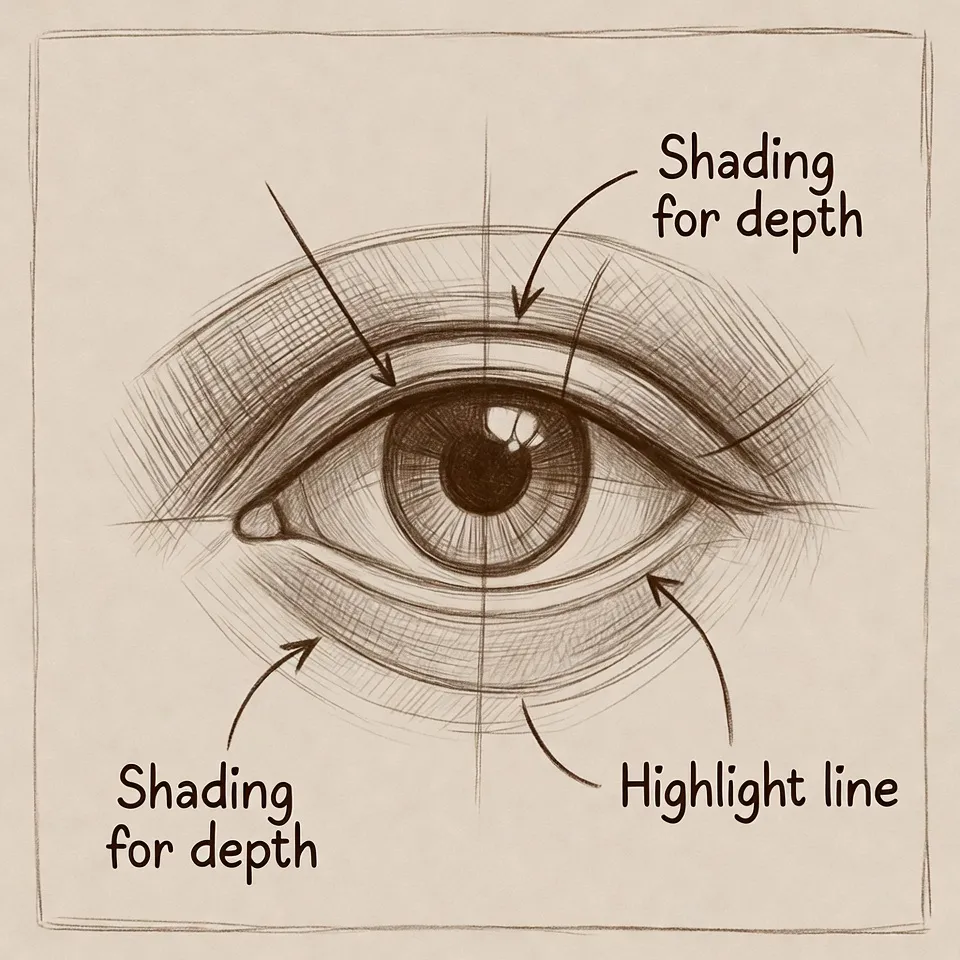
The Shadow Cast by the Upper Eyelid — One of the most commonly missed details. The upper eyelid always casts a shadow onto the top of the iris and the upper sclera. This shadow is dark, soft-edged, and slightly curved. Adding it instantly makes the eye look three-dimensional.
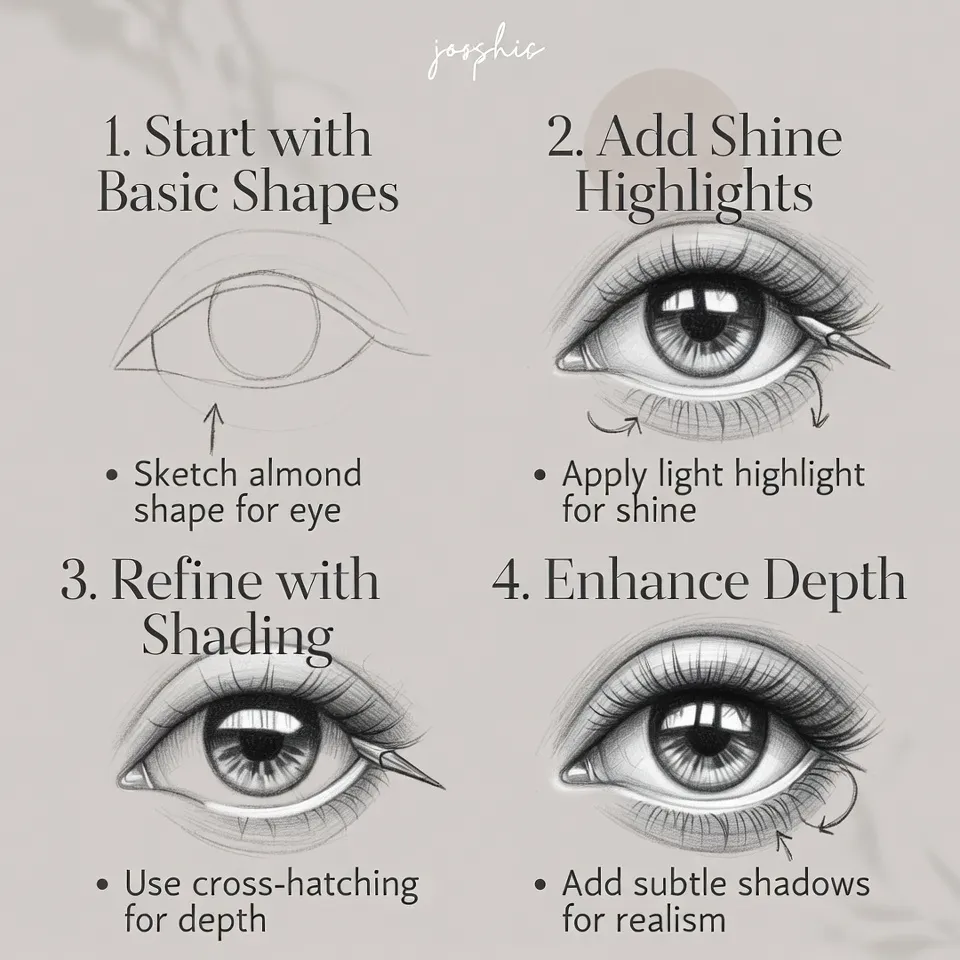
5. Step-by-Step: Building Depth in the Iris {#iris-depth}
This is the heart of realistic eye drawing. Follow these steps in order.
Step 1 — Sketch the Outline Lightly
Using a 2H pencil, sketch the outer iris ring, the pupil circle, and the eyelid shapes. Keep lines very light — you’ll be building many layers on top.
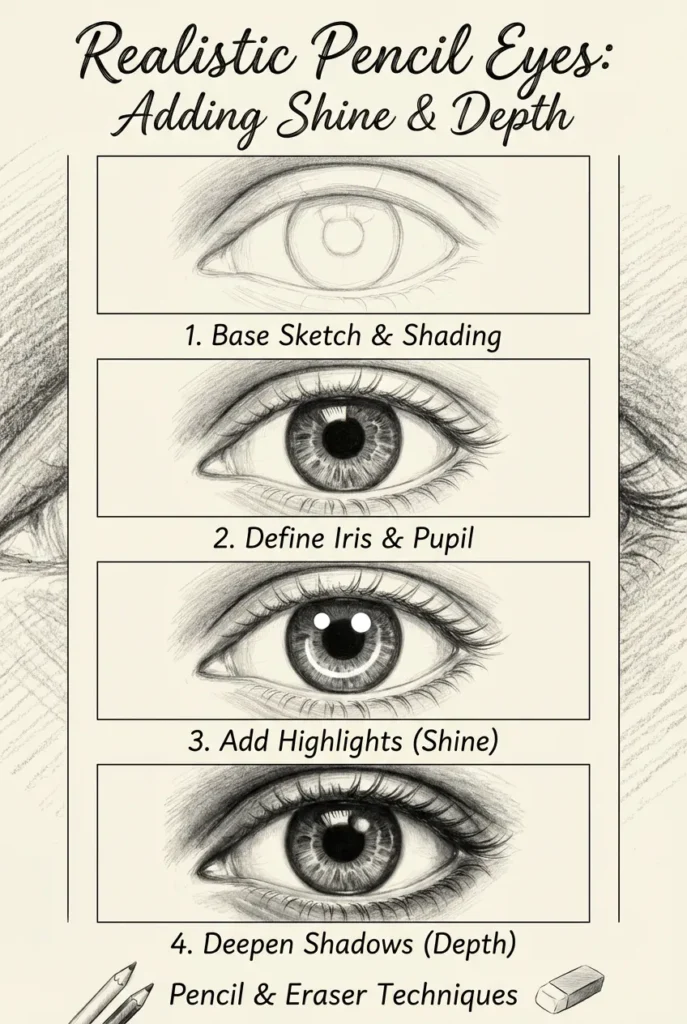
Step 2 — Establish the Eyelid Shadow First
Before touching the iris, block in the shadow cast by the upper eyelid using a 4B pencil, blended smoothly with a medium stump. This shadow sits on the top one-quarter to one-third of the iris. Get this right first and the whole eye starts to feel three-dimensional immediately.
Step 3 — Lay the Base Tone of the Iris
Using a 2B pencil with light, circular strokes, cover the entire iris in an even mid-tone base layer. This is your foundation. Blend gently with a small tortillon.
Step 4 — Add Radial Fibre Lines
With a sharp HB or 2B pencil, draw fine lines radiating outward from the pupil edge toward the outer iris ring. Vary their length and pressure. Some lines should be darker, some lighter. These simulate the fibrous structure of the iris and are critical for realism. Do not draw every line the same — variation is key.
Step 5 — Darken the Outer Iris Ring (Limbal Ring)
The outer edge of the iris — called the limbal ring — is almost always darker than the rest of the iris. Use a 4B or 6B pencil to darken this ring. A crisp, dark limbal ring dramatically increases the depth and intensity of the eye.
Step 6 — Darken Around the Pupil (Collarette Zone)
The area just outside the pupil is often slightly darker than the mid-iris. Add another layer of graphite here, blending carefully to avoid hard edges.
Step 7 — Create the Light Zone in the Lower Iris
Leave or lighten (with a kneaded eraser) a subtle crescent of lighter value in the lower portion of the iris, just above the lower eyelid. This represents transmitted and reflected light from below and is the secret to making the iris look luminous rather than flat.
Step 8 — Final Darks and Final Lights
Go back with a 6B or 8B pencil and deepen any areas that need to be darker. Then use your kneaded eraser shaped to a fine point to lift tiny highlights along some radial lines, suggesting light catching individual iris fibres.
6. Step-by-Step: Adding Shine and Highlights {#highlights}
The highlight is not an afterthought — it is the centrepiece. Plan it from the very beginning.
Planning the Highlight Position
Before laying any graphite, decide where your light source is. For a three-quarter lit portrait, the primary specular highlight usually sits in the upper-left or upper-right of the iris/cornea. Mark this position lightly.
Method 1 — Reserve the White (Best for Beginners)
The cleanest method is to simply avoid shading the highlight area at all. Leave it as bare white paper from the very first stroke. Every layer of graphite you add around it will make the white look brighter by contrast.
Method 2 — Lift with a Kneaded Eraser (Most Flexible)
After shading the iris, take a kneaded eraser shaped into a small point and gently dab or stroke it over the highlight area. This lifts graphite off the paper surface and creates a soft, luminous glow. Best for creating softer, diffused shine.
Method 3 — Erase with a Precision Eraser (Sharpest Highlight)
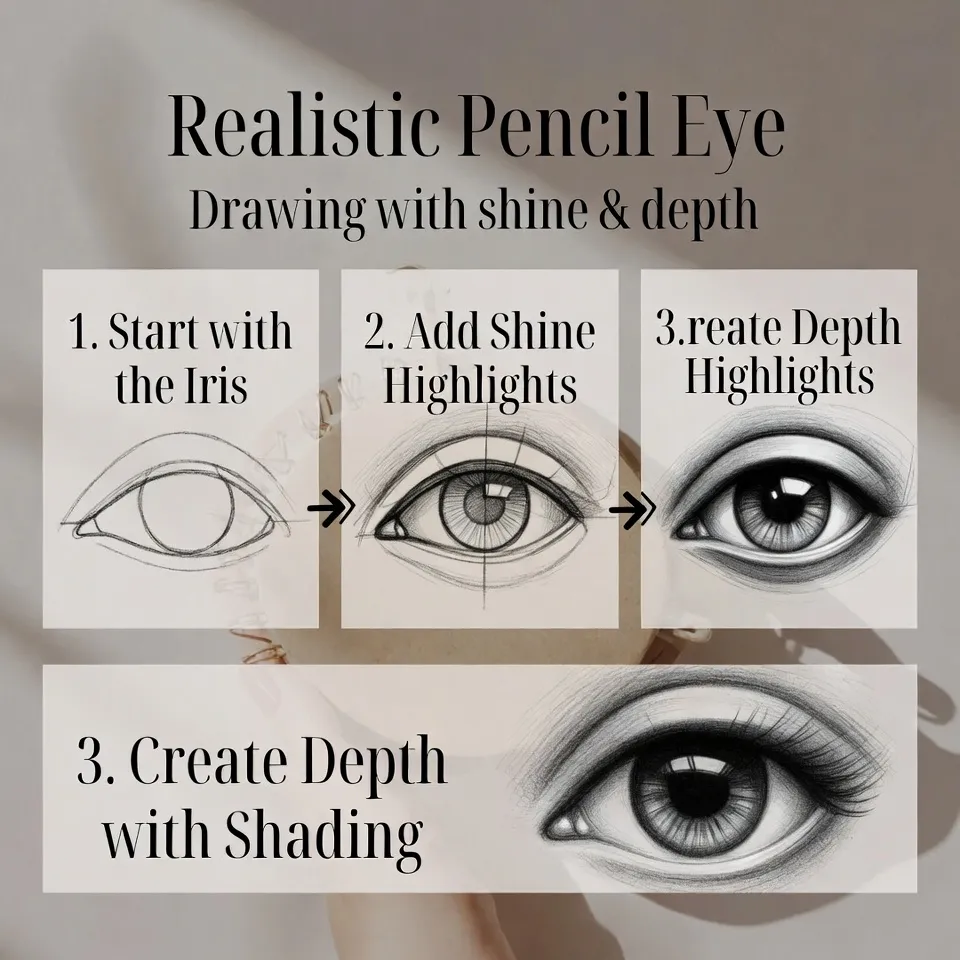
For the sharpest, most intense specular highlight — the type that looks like a glint of direct light — use a Tombow Mono Zero or Staedtler Mars plastic eraser cut to a fine edge. Press firmly and lift cleanly. This gives a near-white result even over dark graphite layers.
Method 4 — White Gel Pen (2026 Standard Method)
The white gel pen method has become the most popular technique among portrait artists in 2025–2026. After completing the entire eye in graphite — iris, pupil, eyelids, everything — apply a small dot or crescent of white gel pen ink directly on top of the darkest area of the cornea. The opacity of the gel ink shows up brilliantly over graphite and creates a highly convincing shine. For best results, apply two thin coats rather than one thick coat.
Secondary Highlights
Beyond the primary corneal highlight, add these secondary light accents for maximum realism:
- A thin, broken highlight along the waterline (inner lower eyelid rim)
- A subtle catch-light on the lower sclera, just above the lower lid
- A very faint highlight crescent in the lower iris (the transmitted light zone described above)
7. Shading the Pupil for Maximum Realism
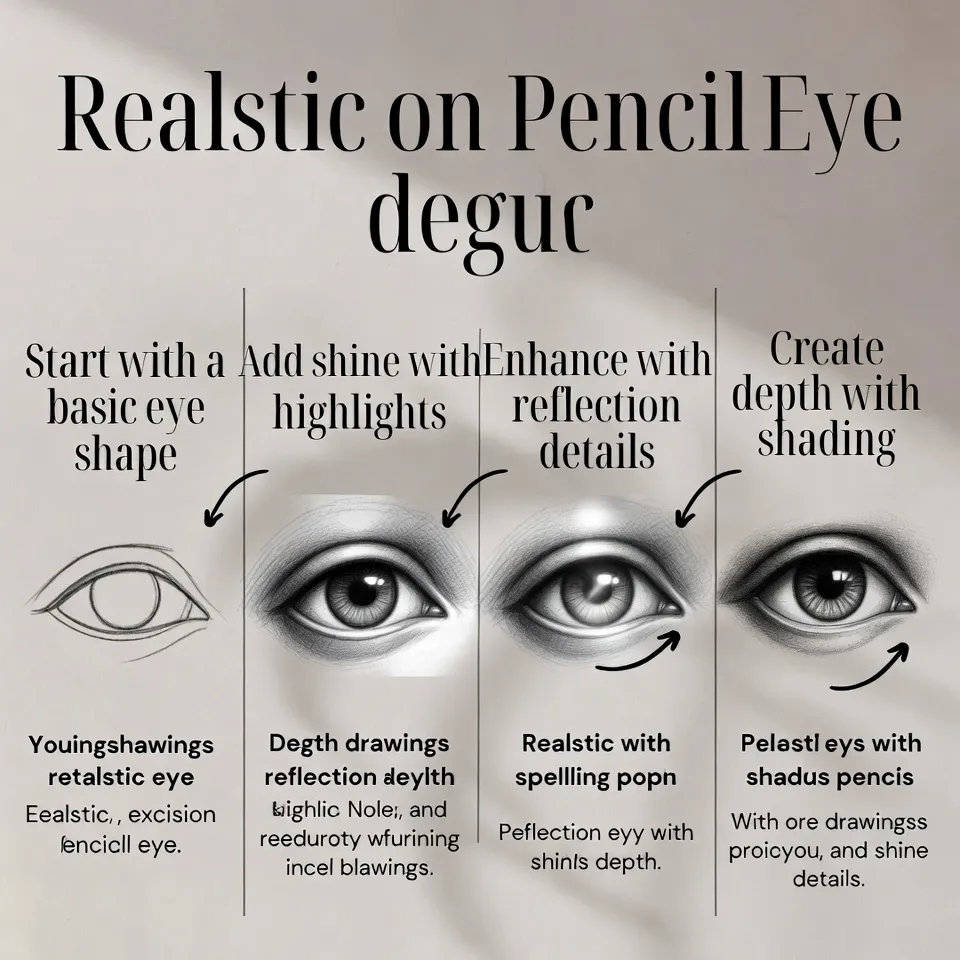
The pupil is the anchor of the entire eye. Everything around it is measured against how dark it is.
Use your darkest pencil — 8B or 9B — to fill the pupil. Apply multiple layers, each slightly different in direction (circular, then cross-hatched, then circular again) to build maximum density. Blend with a small stump.
One subtle but powerful trick: leave the very edge of the pupil border slightly lighter than the interior for the first layer, then darken it again on subsequent layers. This creates the impression of a deep, hollow aperture rather than a flat black disc.
Also — and this is important — the pupil is never perfectly centred in the iris when viewed at any angle other than straight-on. In three-quarter view, the pupil shifts slightly toward the near side. Getting this foreshortening right is one of the markers of an advanced portrait artist.
8. Blending Techniques That Actually Work {#blending}
Blending is where most beginners waste time using the wrong tool. Here is a clear breakdown:
Tortillon (Spiral Paper Stump) — Best for smooth, even blending of large areas like the iris base coat and sclera. Use circular or back-and-forth motions with light pressure.
Blending Stump (Pressed Paper) — Slightly stiffer than a tortillon. Better for blending fine iris details and transitioning between tones without losing all texture.
Clean Brush — A soft flat brush (watercolour or oil brush, clean and dry) is excellent for removing loose graphite dust and for very subtle, whisper-light blending that doesn’t flatten all the texture.
Fingertip — Works in a pinch but deposits oils onto the paper, which can repel future graphite layers. Use sparingly, and only in areas you’ve already established fully.
Rolled Tissue — Useful for blending skin tones around the eye but too broad for iris details.
Key 2026 Tip: Keep a dirty stump and a clean stump. Use the dirty stump (loaded with graphite from previous use) to add subtle tone to lighter areas while blending. Use the clean stump for blending only, without adding graphite.
9. The Sclera, Eyelid, and Surrounding Skin {#sclera}
A beautifully rendered iris surrounded by a clumsily drawn sclera will always look wrong. The surrounding elements of the eye are just as important.
The Sclera (White of the Eye) Shade it with a very light 2H or H pencil. Add subtle veining using a sharp HB — thin, organic curved lines spreading from the tear duct outward. Darken the corners (especially the inner corner) and the area directly under the upper eyelid where shadow falls. The sclera is also slightly curved, so it has a subtle highlight of its own — usually along the lower half — that you can leave as paper white.
The Upper Eyelid The upper eyelid has a fold, a crease, and a lash line. The crease (the fold of skin above the eyelid) is typically a soft, curved shadow line. The lash line itself is dark and tapers at both ends. Eyelashes grow in a fan shape, curving outward and upward from the lash line — draw them individually with a sharp, dark pencil, varying length and direction. They should taper to a fine point at the tip.
The Lower Eyelid The lower lid is thicker than most people draw it. It has a subtle thickness (the lower lid margin) which often catches light. The lower lashes are shorter, lighter, and grow downward. Don’t overdraw lower lashes — suggestion is more realistic than every single lash.
Skin Around the Eye Use long, smooth blending strokes for the skin. Build layers gradually. The under-eye area typically has soft shadow, especially close to the lower lid. The brow bone above catches the most light. The inner corner (lacrimal area) is complex — take time to study reference photos of this specific area.
10. Common Mistakes and How to Fix Them in 2026 {#mistakes}
Mistake 1: The Iris is One Flat Tone Fix: Go back and add the eyelid shadow (top of iris), darken the limbal ring, and lighten the lower iris zone. These three changes alone will transform a flat iris.
Mistake 2: The Highlight is Too Large Fix: A corneal highlight larger than about 3–5% of the iris diameter looks cartoonish. Reduce it. Use a precise eraser to shrink an oversize highlight area.
Mistake 3: No Eyelid Shadow Fix: Blend a curved shadow of 4B graphite across the top quarter of the iris. This single addition adds enormous depth.
Mistake 4: The Pupil Is Not Dark Enough Fix: Layer more graphite. 8B over 6B over 4B. The pupil should be the absolute darkest value in your drawing.
Mistake 5: Mechanical, Uniform Iris Lines Fix: Vary your pressure, angle, and spacing. Some radial lines should break partway through. Some should cluster together. Organic variation is the key to a believable iris texture.
Mistake 6: Ignoring the Waterline Fix: Add a thin, slightly lighter line along the inner rim of the lower eyelid. This is one of the fastest, highest-impact details you can add to a realistic eye drawing.
Mistake 7: Drawing Both Eyes Separately Instead of Together Fix (2026 practice): Use a mirror grid or digital reference overlay (many artists in 2026 use free apps like LineofAction or Sketchbook reference mode) to ensure both eyes in a portrait are balanced in angle, size, and tonal value.
11. Advanced Techniques for Hyper-Realistic Eyes
Once you have the fundamentals solid, these advanced methods push your pencil eye drawings into hyper-realistic territory.
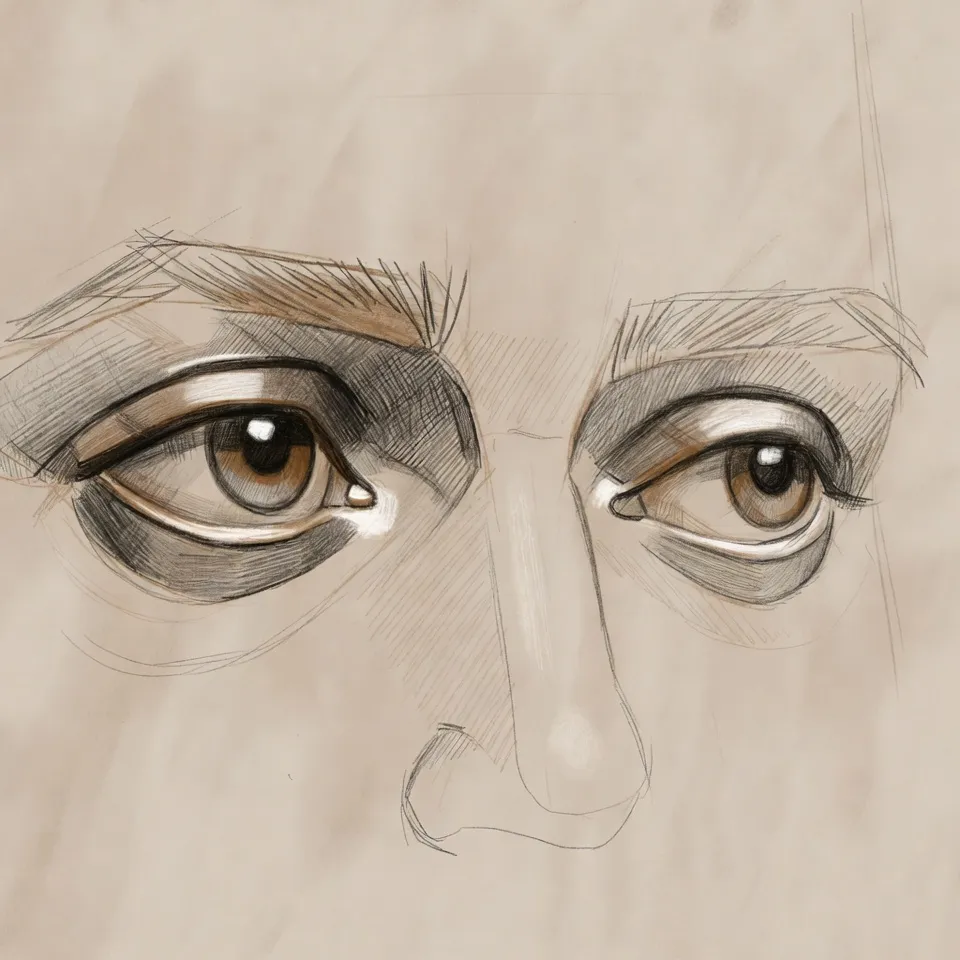
Subtractive Drawing Method Instead of building from white paper to dark, start by covering your entire paper in a mid-tone graphite layer (using a broad 4B stick or powder graphite rubbed in with a cloth). Then use erasers to “draw” the light areas — the iris highlights, the sclera brightness, the catchlight — and dark pencils to reinforce the shadow areas. This gives you more tonal control and a more painterly, photographic quality.
Graphite Powder for Base Tones Available widely in 2026, loose graphite powder applied with a cotton ball or pad creates extraordinarily smooth, photographic base tones in the iris and skin. Lay the powder base first, then work detailed pencil marks on top.
Layering Different Pencil Brands In 2026, experienced portrait artists frequently layer different brand graphite pencils because each brand has a slightly different pigment density and tooth-interaction. Faber-Castell lays differently than Staedtler, which layers differently than Tombow. Layering two or three brands can create unexpected depth and luminosity.
Carbon Pencil for Deep Blacks Standard graphite becomes reflective and shiny at maximum darkness, which can actually reduce the impression of depth on the pupil. Carbon pencils (such as Wolff’s Carbon or Derwent Tinted Charcoal in black) are matte and absorb more light, giving you a true, non-shiny black that reads as genuinely deep. Many hyper-realist artists in 2026 switch to carbon pencil for pupils and lash lines.
Colorless Blender Pencil A colorless blender pencil (such as those from Prismacolor or Faber-Castell) pressed over graphite layers burnishes them, filling the paper’s tooth and creating a glass-like, smooth surface — perfect for the wet surface of the cornea and sclera.
Practice Exercises for Fast Improvement
These targeted exercises will accelerate your skill development in 2026:
Exercise 1 — Value Scale Practice Draw a 10-box value scale from pure white (paper) to maximum dark (8B). Do this daily for one week. Train your eye to see and control the full tonal range.
Exercise 2 — Isolated Iris Studies Draw just the iris — no eyelids, no sclera — 10 times on one sheet. Try a different approach each time: pure circles, radial lines, stippling, blending only, subtractive. Analyse which methods look most convincing.
Exercise 3 — Highlight Lifting Practice On a fully shaded grey square, practice lifting highlights in different shapes with a kneaded eraser. Learn how much pressure gives a soft glow versus a hard bright light.
Exercise 4 — Reference Photo Grid Study Find a high-resolution portrait photograph with well-lit eyes. Use a grid overlay (8×8) and reproduce the eye section by section, matching values as closely as possible. This trains tonal accuracy faster than any other method.
Exercise 5 — 5-Minute Eye Sketches Do 10 fast, 5-minute eye sketches from different reference photos. Speed forces you to prioritise the most important marks: the eyelid shadow, the dark pupil, and the catchlight. After 30 sessions of this, those three elements become instinctive.
Final Thoughts
Drawing realistic pencil eyes that truly shine and feel deep is one of the most rewarding skills you can develop as an artist — and in 2026, there are more resources, tools, and techniques available than at any previous point in the history of pencil drawing.
The formula is actually straightforward once you see it clearly: deep darks in the pupil and upper iris shadow, clean bright highlights on the cornea, radial texture in the iris, and smooth transitions everywhere in between. Practice each element separately. Then bring them together.
The artists whose pencil eye drawings look like photographs are not more talented than you — they simply understand the structure of light on a curved, reflective sphere, and they are patient enough to build their values in careful layers rather than rushing to the finish.
