

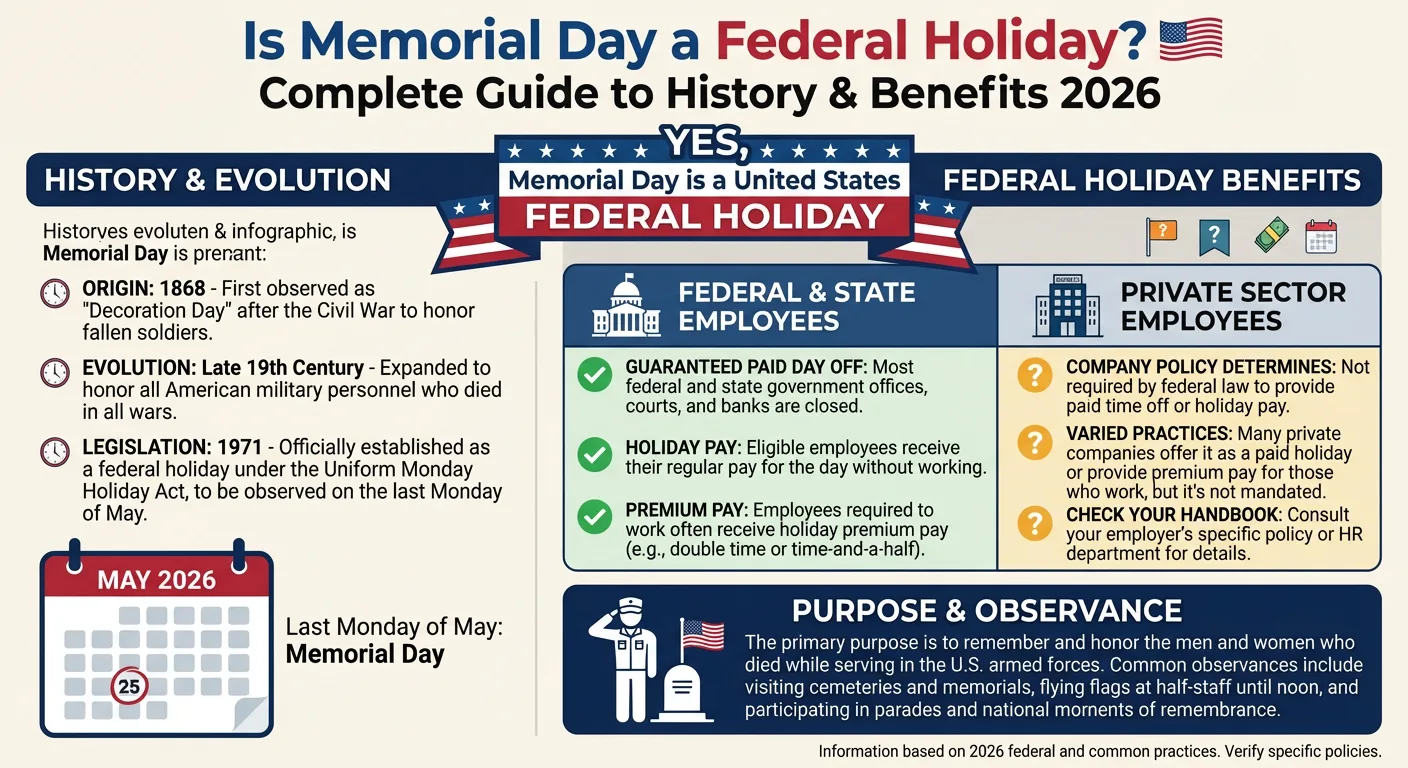
Is Memorial Day a federal holiday? This question becomes particularly relevant as Americans plan their schedules, anticipate long weekends, and wonder about workplace compensation. The answer is definitively yes—Memorial Day is a federal holiday, but understanding what that designation means, how it became official, and how it affects various aspects of American life requires deeper exploration.
This comprehensive guide answers every question about Memorial Day federal holiday status, from its historical establishment to modern implications for workers, banks, government offices, and businesses. Whether you’re an employer determining holiday pay policies, an employee wondering about time off, or simply curious about this important American observance, you’ll find authoritative information here.
Is Memorial Day a Federal Holiday?
Yes, Memorial Day is unequivocally a federal holiday in the United States. This official designation carries specific legal implications and affects how government offices, federal employees, banks, and many private-sector businesses operate on the last Monday of May each year.
What Makes a Holiday “Federal”?
Federal holiday status means the holiday is recognized by the United States federal government as an official day of observance. Federal holidays are established through congressional legislation and presidential approval, becoming part of the United States Code (specifically Title 5, Section 6103).
When Memorial Day or any federal holiday occurs, the following typically happens:
Federal Government Offices Close: All non-essential federal government offices close for business. This includes Social Security offices, passport agencies, federal courts, and most administrative departments.
Federal Employees Receive Paid Time Off: Federal workers receive paid leave for Memorial Day without using vacation days or personal time.
Federal Institutions Observe the Holiday: The Federal Reserve System closes, affecting banking operations nationwide. The U.S. Postal Service suspends mail delivery. Federal courts do not conduct proceedings.
Stock Markets Close: The New York Stock Exchange and NASDAQ observe federal holidays, suspending trading for the day.
Memorial Day’s Official Federal Status
Memorial Day holds official federal holiday designation under United States Code Title 5, Section 6103(a), which lists all federal holidays. The statute specifically identifies Memorial Day as “the last Monday in May” rather than a fixed calendar date, ensuring it always creates a three-day weekend for federal observance.
This legal codification means Memorial Day federal holiday status isn’t merely traditional or customary—it’s mandated by federal law. Congress established this status, and only Congress can modify or eliminate it.
When Did Memorial Day Become a Federal Holiday?
Memorial Day became an official federal holiday in 1971, though its journey to that status spans over a century of American history. Understanding this evolution reveals how Memorial Day transformed from regional observances to unified national commemoration.
The Path to Federal Recognition: 1868-1971
1868: First Official Observance General John A. Logan, commander of the Grand Army of the Republic (a Union veterans organization), issued General Order No. 11 on May 5, 1868, establishing May 30 as Decoration Day—a time for decorating graves of Civil War soldiers. This date was chosen because flowers would be in bloom nationwide.
While not yet a federal holiday, this proclamation created the first coordinated national observance. Government buildings flew flags at half-staff, and many communities held ceremonies, but workers didn’t receive official time off.
1873: New York Becomes First State New York became the first state to officially recognize Decoration Day as a state holiday in 1873. By 1890, all Northern states had followed suit, though Southern states generally chose different dates to honor Confederate dead.
Early 1900s: Growing but Inconsistent Recognition Throughout the early twentieth century, Decoration Day (gradually becoming known as Memorial Day) gained recognition, but observance remained inconsistent. Some states granted workers time off; others didn’t. Federal employees often worked regular schedules.
1938: Memorial Day Name Becomes Common By 1938, the name “Memorial Day” had become more prevalent than “Decoration Day,” reflecting evolution from Civil War-specific observance to honoring all American military dead.
1968: Uniform Monday Holiday Act The pivotal moment arrived with the Uniform Monday Holiday Act, passed by Congress in 1968. This legislation moved several holidays, including Memorial Day, to Mondays to create three-day weekends for federal workers. The act aimed to reduce employee absenteeism and boost economic activity through extended weekend travel and recreation.
1971: Official Implementation The Uniform Monday Holiday Act took effect in 1971, officially establishing Memorial Day as a federal holiday observed on the last Monday in May. This year—1971—definitively answers “when did Memorial Day become a federal holiday.”
Presidential Role in Memorial Day Federal Holiday Status
While Congress passes legislation establishing federal holidays, presidents play important roles. President Lyndon B. Johnson signed the Uniform Monday Holiday Act in 1968, though implementation occurred under President Richard Nixon’s administration in 1971.
No single president “made” Memorial Day a federal holiday, contrary to common misconceptions. The legislative process involved both congressional action and presidential approval, representing collaborative federal government function.
What Year Did Memorial Day Become an Official Federal Holiday?
To directly answer this frequently searched question: Memorial Day became an official federal holiday in 1971 when the Uniform Monday Holiday Act took effect. While observed informally and in various states for over a century before this, 1971 marks the year of official federal recognition with mandated government closure and federal employee paid leave.
Is Memorial Day a Federal Holiday in the USA?
Yes, Memorial Day is exclusively a federal holiday in the United States of America. This observance is unique to American history and military tradition, not celebrated as a federal holiday in other countries.
Memorial Day vs. Other Countries
Is Memorial Day a Federal Holiday in Canada? No, Memorial Day is not observed in Canada. Canada has its own Remembrance Day on November 11 (equivalent to America’s Veterans Day), which honors Canadian military members who died in service. Canadians do not celebrate American Memorial Day, and it holds no official status in Canadian federal or provincial law.
International Equivalents While Memorial Day is specific to the United States, many countries observe similar remembrance days:
- United Kingdom: Remembrance Sunday (second Sunday in November)
- Australia and New Zealand: ANZAC Day (April 25)
- France: Armistice Day (November 11)
- Israel: Yom Hazikaron (day before Independence Day)
These observances serve similar purposes—honoring military sacrifice—but Memorial Day federal holiday status applies only within American borders.
Is Memorial Day a Federal Holiday in the United States?
This question, phrased slightly differently, receives the same answer: Yes, Memorial Day is absolutely a federal holiday throughout the United States, observed uniformly across all fifty states, the District of Columbia, and U.S. territories.
All federal offices nationwide close on Memorial Day regardless of location. A federal employee in Alaska receives the same paid Memorial Day holiday as one in Florida, Maine, or Hawaii. This uniformity distinguishes federal holidays from state holidays, which individual states control independently.
Is Memorial Day a National or Federal Holiday?
Memorial Day is both a national holiday and a federal holiday, though these terms carry distinct meanings that sometimes cause confusion.
Federal Holiday Definition
A federal holiday is one officially recognized by the federal government through legislation. Federal holidays trigger mandatory closures of federal offices and paid leave for federal employees. Memorial Day meets this definition precisely.
National Holiday Definition
A national holiday refers broadly to observances recognized and celebrated throughout a nation, whether officially designated or culturally significant. National holidays may lack official government recognition but maintain widespread observance.
In Memorial Day’s case, it qualifies as both:
- Federal holiday because Congress officially designated it with specific legal requirements
- National holiday because Americans across the country observe it regardless of government employment status
State vs. Federal Holiday Distinction
Is Memorial Day a State or Federal Holiday? Memorial Day is primarily a federal holiday, though all fifty states also recognize it as a state holiday. This dual recognition means:
- Federal government offices close (federal holiday status)
- State government offices close (state holiday status)
- Many private businesses close or offer holiday pay (cultural national holiday status)
The federal designation came in 1971, but states individually determine whether their employees receive the day off and whether state offices close. Fortunately, all states align with federal Memorial Day observance, creating uniform national recognition.
Is Memorial Day a Paid Federal Holiday?
For federal employees, yes—Memorial Day is absolutely a paid federal holiday. Federal workers receive their regular wages for Memorial Day without using vacation days, sick leave, or personal time. However, “paid holiday” status becomes more complex when considering private-sector employment.
Federal Employee Holiday Pay
Federal employees governed by Title 5 of the United States Code receive paid time off for all designated federal holidays, including Memorial Day. This benefit is mandatory, not discretionary, for agencies and departments employing federal workers.
Full-Time Federal Employees: Receive eight hours of holiday pay at their regular rate if Memorial Day falls on a scheduled workday.
Part-Time Federal Employees: Receive holiday pay proportional to their regular work schedule. If a part-time employee normally works Mondays, they receive holiday pay for Memorial Day.
Federal Employees Required to Work: Those in essential positions (such as security, healthcare, or emergency services) who must work on Memorial Day receive both their regular pay for working plus holiday premium pay.
Is Memorial Day a Federal Holiday Double Pay?
Federal employees who work on Memorial Day don’t receive “double pay” in the traditional sense. Instead, they receive:
- Regular pay for hours worked on Memorial Day
- Holiday premium pay equal to their base hourly rate for the hours worked
This effectively means federal employees working Memorial Day receive double their base hourly rate (regular pay + holiday premium), though overtime rates may apply differently based on specific circumstances and employee classification.
Is Memorial Day a Federal Holiday Time and a Half?
The “time and a half” question applies more to private-sector employment than federal positions. Federal employees working Memorial Day receive their base rate plus holiday premium (effectively double pay), not time-and-a-half.
For private-sector employees, time-and-a-half or other premium pay for Memorial Day depends entirely on:
- State labor laws (which vary significantly)
- Company policies and employee handbooks
- Union contracts or collective bargaining agreements
- Industry standards and competitive practices
Important clarification: Federal law does NOT require private employers to pay premium rates for federal holidays, including Memorial Day. The Fair Labor Standards Act (FLSA) mandates overtime pay for hours exceeding 40 per week but doesn’t address holiday pay. Any premium pay private-sector workers receive for Memorial Day comes from employer policy or state law, not federal requirements.
Is Memorial Day a Federal Paid Holiday for Private Employees?
This is where confusion often arises. Memorial Day is a federal holiday, but that designation doesn’t automatically guarantee paid time off for private-sector workers.
Private employers can:
- Close for Memorial Day and pay employees (common practice)
- Close for Memorial Day without paying employees (less common)
- Remain open and pay premium rates for holiday work (retail, hospitality)
- Remain open with regular pay (some service industries)
Most established companies offer Memorial Day as a paid holiday to remain competitive in hiring and retention, but this represents company policy choice, not legal requirement for private employers.
Is Memorial Day a Federal Holiday for Banks?
Yes, Memorial Day is a federal banking holiday, meaning banks nationwide close in observance. This closure directly results from Federal Reserve System observance of federal holidays.
Federal Reserve and Banking Closures
The Federal Reserve System, America’s central banking system, observes all federal holidays including Memorial Day. When the Federal Reserve closes, several cascading effects occur:
Federal Reserve Banks Close: All twelve Federal Reserve Banks suspend operations on Memorial Day, preventing certain interbank transactions and check clearing processes.
Commercial Banks Close: Most commercial banks (Bank of America, Wells Fargo, Chase, etc.) close their branches on Memorial Day. While not legally required to close, banks cannot process certain transactions without Federal Reserve operations, making closure practical.
Credit Unions Follow Suit: Credit unions typically observe the same holiday schedule as commercial banks, closing for Memorial Day.
Online Banking Continues: While physical branches close on Memorial Day, online and mobile banking services generally remain available for account checks, transfers between accounts at the same institution, and bill pay scheduling. However, transactions requiring Federal Reserve processing (such as wire transfers or check deposits) won’t complete until the next business day.
Is Memorial Day a Federal Holiday Banks Closed?
Yes, Memorial Day is a federal holiday when banks close. Customers should plan ahead for Memorial Day weekend, ensuring they have adequate cash and completing time-sensitive transactions before the long weekend. ATMs remain operational for cash withdrawals and deposits, though deposit processing may be delayed until Tuesday.
Memorial Day 2025, 2026, and Beyond: Federal Holiday Dates
Memorial Day’s federal holiday status continues annually on the last Monday of May, providing predictable scheduling for years ahead.
Is Memorial Day 2025 a Federal Holiday?
Yes, Memorial Day 2025 is a federal holiday occurring on Monday, May 26, 2025. Federal offices close, banks suspend operations, and federal employees receive paid leave on this date.
Memorial Day 2026 Federal Holiday
Memorial Day 2026 falls on Monday, May 25, 2026, maintaining its federal holiday status with all associated closures and benefits.
Future Memorial Day Federal Holiday Dates
| Year | Memorial Day Date | Day of Week | Federal Holiday Status |
|---|---|---|---|
| 2025 | May 26 | Monday | Yes – Federal Holiday |
| 2026 | May 25 | Monday | Yes – Federal Holiday |
| 2027 | May 31 | Monday | Yes – Federal Holiday |
| 2028 | May 29 | Monday | Yes – Federal Holiday |
| 2029 | May 28 | Monday | Yes – Federal Holiday |
| 2030 | May 27 | Monday | Yes – Federal Holiday |
The last-Monday-in-May designation ensures Memorial Day remains a federal holiday indefinitely unless Congress changes the law.
Understanding Your Memorial Day Federal Holiday Benefits
Determine Your Employment Status and Eligibility
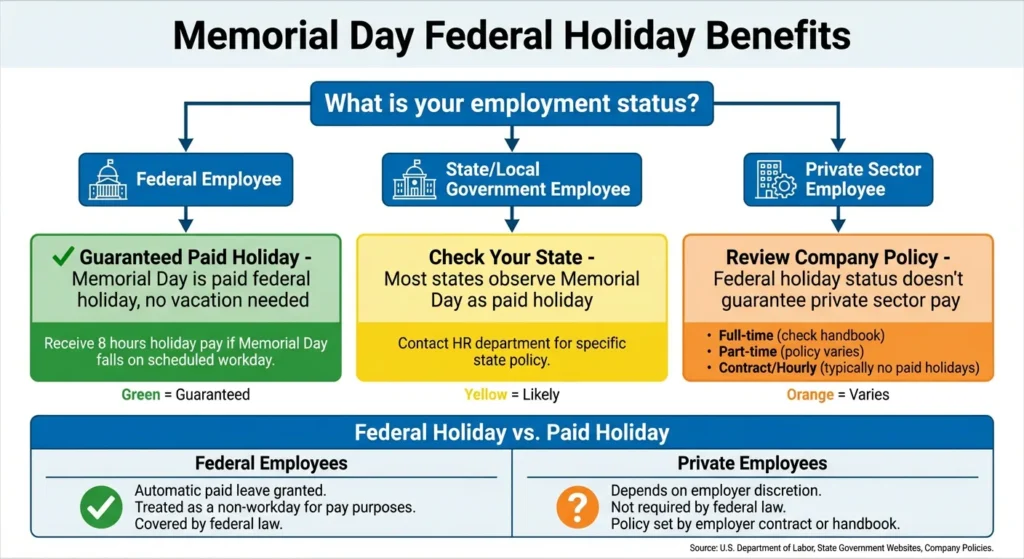
Decision tree infographic helping individuals determine Memorial Day federal holiday benefits. Starting at top: “What is your employment status?” branches into three main categories. Left branch: “Federal Employee” leads to green checkmark box stating “✓ Guaranteed Paid Holiday – Memorial Day is paid federal holiday, no vacation needed” with sub-note “Receive 8 hours holiday pay if Memorial Day falls on scheduled workday.” Middle branch: “State/Local Government Employee” leads to yellow box “Check Your State – Most states observe Memorial Day as paid holiday” with instruction “Contact HR department for specific state policy.” Right branch: “Private Sector Employee” leads to orange box “Review Company Policy – Federal holiday status doesn’t guarantee private sector pay” with sub-categories: “Full-time (check handbook),” “Part-time (policy varies),” “Contract/Hourly (typically no paid holidays).” Bottom section displays “Federal Holiday vs. Paid Holiday” comparison table showing federal employees get automatic paid leave while private employees depend on employer discretion. Color-coded legend: Green = Guaranteed, Yellow = Likely, Orange = Varies.
Verify Holiday Pay and Premium Rates
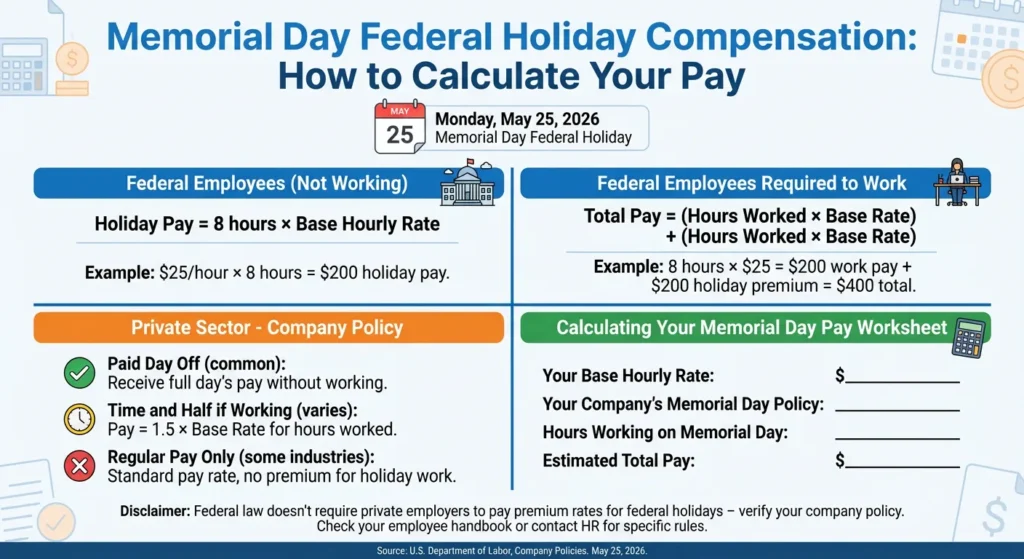
Visual guide showing how to calculate Memorial Day federal holiday compensation for different scenarios. Layout divided into four quadrants. Top-left: “Federal Employees” displays formula “Holiday Pay = 8 hours × Base Hourly Rate” with example “$25/hour × 8 hours = $200 holiday pay.” Top-right: “Federal Employees Required to Work” shows “Total Pay = (Hours Worked × Base Rate) + (Hours Worked × Base Rate)” with example “8 hours × $25 = $200 work pay + $200 holiday premium = $400 total.” Bottom-left: “Private Sector – Company Policy” illustrates three common scenarios: “Paid Day Off (common),” “Time and Half if Working (varies),” “Regular Pay Only (some industries).” Bottom-right: “Calculating Your Memorial Day Pay” provides worksheet with blanks: “Your Base Hourly Rate: $___,” “Your Company’s Memorial Day Policy: ___,” “Hours Working on Memorial Day: ,” “Estimated Total Pay: $.” Footer includes disclaimer: “Federal law doesn’t require private employers to pay premium rates for federal holidays – verify your company policy.” Chart includes small calendar showing Monday, May 25, 2026 highlighted as “Memorial Day Federal Holiday.”
Plan for Federal Holiday Service Closures
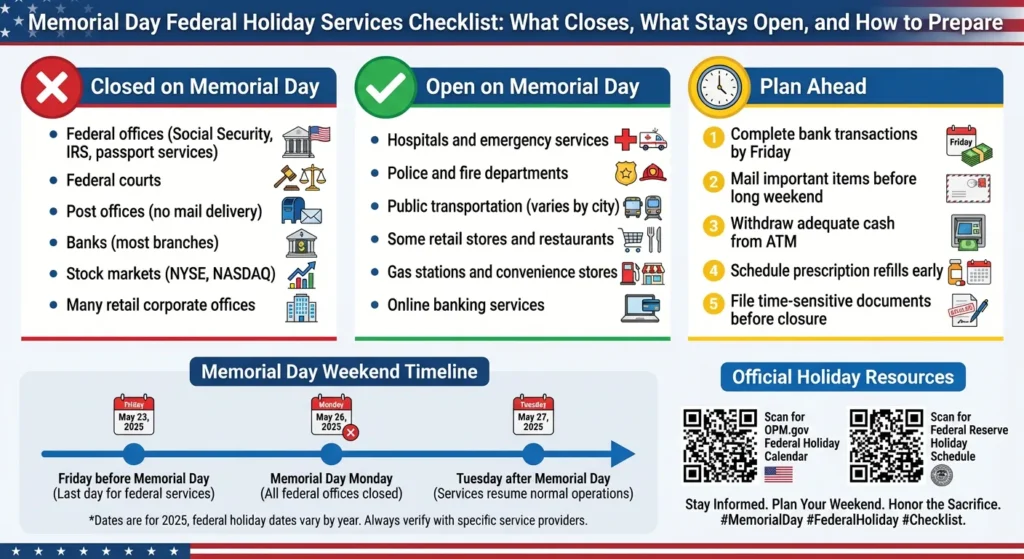
Comprehensive checklist infographic showing which services close for Memorial Day federal holiday. Organized into five sections with icons. Section 1 “Closed on Memorial Day” (red X icons): Federal offices (Social Security, IRS, passport services), Federal courts, Post offices (no mail delivery), Banks (most branches), Stock markets (NYSE, NASDAQ), Many retail corporate offices. Section 2 “Open on Memorial Day” (green check icons): Hospitals and emergency services, Police and fire departments, Public transportation (varies by city), Some retail stores and restaurants, Gas stations and convenience stores, Online banking services. Section 3 “Plan Ahead” (yellow clock icon): Complete bank transactions by Friday, Mail important items before long weekend, Withdraw adequate cash from ATM, Schedule prescription refills early, File time-sensitive documents before closure. Section 4 “Memorial Day Weekend Timeline”: Friday before Memorial Day (Last day for federal services), Memorial Day Monday (All federal offices closed), Tuesday after Memorial Day (Services resume normal operations). Section 5 includes QR codes linking to OPM.gov federal holiday calendar and Federal Reserve holiday schedule.
Related Federal Holidays and Observances
Understanding Memorial Day’s relationship to other federal holidays and observances provides context for its significance and helps distinguish it from similar commemorations.
Is Veterans Day a Federal Holiday?
Yes, Veterans Day (November 11) is also a federal holiday. However, Veterans Day and Memorial Day serve different purposes:
Memorial Day (last Monday in May) specifically honors military personnel who died in service to the United States. It’s a day of mourning and remembrance for the fallen.
Veterans Day (November 11) honors all military veterans—living and deceased—who served in the U.S. Armed Forces. It celebrates military service generally, not specifically those who died.
Both maintain federal holiday status, closing federal offices and providing paid leave to federal employees.
Is Confederate Memorial Day a Federal Holiday?
No, Confederate Memorial Day is not a federal holiday. Several Southern states observe Confederate Memorial Day on various dates (typically in April, May, or June depending on the state), but this observance holds no federal recognition.
Confederate Memorial Day is exclusively a state holiday in states choosing to observe it, such as:
- Alabama (fourth Monday in April)
- Mississippi (last Monday in April)
- South Carolina (May 10)
- Texas (January 19, as part of Confederate Heroes Day)
Federal employees do not receive paid leave for Confederate Memorial Day, and federal offices remain open. The observance remains controversial given its origins in honoring Confederate soldiers who fought against the United States.
Is Peace Officers Memorial Day a Federal Holiday?
Peace Officers Memorial Day (May 15) is not a federal holiday in the traditional sense. President John F. Kennedy established it in 1962 through presidential proclamation, and it was officially designated by congressional joint resolution in 1994.
However, Peace Officers Memorial Day does not trigger federal office closures or mandatory paid leave for federal employees. It’s a federal observance or commemoration rather than a federal holiday.
The distinction is important:
- Federal holidays (like Memorial Day) = offices close, paid leave
- Federal observances (like Peace Officers Memorial Day) = presidential proclamation, commemorative events, but offices remain open
Police Week (the calendar week containing May 15) provides time for honoring law enforcement officers killed in the line of duty, but regular work schedules continue for most Americans.
Is Memorial Day Weekend a Federal Holiday?
Memorial Day itself—the last Monday in May—is the federal holiday. The weekend preceding it (Saturday and Sunday) are not federal holidays but rather regular weekend days that happen to create a long weekend when combined with Monday’s federal holiday.
Three-Day Weekend Confusion
When people ask “Is Memorial Day weekend a federal holiday?”, they’re typically asking whether the entire three-day period (Saturday-Sunday-Monday) constitutes the holiday. The technical answer:
Saturday and Sunday: Regular weekend days (not federal holidays) Monday: Memorial Day federal holiday
However, the practical effect creates a three-day period of celebration and observance. Many businesses close for the entire weekend, and Americans commonly refer to “Memorial Day weekend” as a single extended observance.
Friday Before Memorial Day
Some federal agencies grant administrative leave on the Friday before Memorial Day, and some private companies close early or grant the full day off. However, this is not part of the federal holiday. Friday remains a regular workday unless specific agencies or employers choose otherwise.
If you see businesses or federal offices closed on Friday before Memorial Day, it’s due to:
- Administrative leave policies (federal agencies can grant at their discretion)
- Company policy providing extra time off
- Individual vacation day usage
The Friday before Memorial Day is not legally a federal holiday.
Why Is Memorial Day a Federal Holiday?
Memorial Day achieved federal holiday status to ensure Americans nationwide pause to honor military personnel who died defending the United States. The federal designation serves several important purposes:
Honoring the Fallen Uniformly
Federal holiday status ensures all Americans, regardless of location or employer, have the opportunity to participate in memorial observances. When the federal government closes and grants paid leave, it sends a clear message about the day’s importance.
Without federal holiday status, Memorial Day observance would remain scattered and inconsistent, with some Americans working while others commemorated. Federal designation creates unified national remembrance.
Economic and Practical Benefits
The Uniform Monday Holiday Act’s architects recognized that three-day weekends benefit American workers and the economy. Extended weekends reduce absenteeism (workers are less likely to extend weekends with sick days when Monday is already off), boost travel and tourism industries, and improve worker morale.
While these practical considerations influenced the timing change (from fixed May 30 to last Monday in May), they don’t diminish Memorial Day’s solemn purpose. The three-day weekend simply makes memorial participation more accessible.
Demonstrating National Values
A nation’s federal holidays reflect its values and priorities. By designating Memorial Day as a federal holiday, the United States officially declares that honoring military sacrifice ranks among our highest collective priorities—worthy of pausing government operations and guaranteeing time for remembrance.
This symbolic importance reinforces Memorial Day’s significance for current and future generations, ensuring the sacrifices of over one million American service members who died in conflicts from the Revolutionary War through present day receive permanent national recognition.
Memorial Day Federal Holiday Pay: State-by-State Variations
While Memorial Day maintains uniform federal holiday status nationwide, state laws regarding private-sector holiday pay vary significantly.
States Requiring Holiday Pay
Massachusetts: Known as “blue laws,” Massachusetts requires premium pay (time-and-a-half) for certain retail employees working on Memorial Day and other legal holidays. This is one of the few states mandating holiday premium pay.
Rhode Island: Requires premium pay for certain employees working on Memorial Day, though exemptions exist for small businesses and specific industries.
Most Other States: Do not legally require private employers to pay premium rates for Memorial Day work. Holiday pay comes from company policy, not state mandate.
State Government Employee Benefits
All fifty states recognize Memorial Day as a state holiday for their government employees, providing paid leave when it falls on a regular workday. State workers typically receive benefits comparable to federal employees for Memorial Day observance.
Private Sector Norms by State
Even in states without legal requirements, most established private employers offer Memorial Day as a paid holiday due to:
- Competitive pressure in hiring and retention
- Industry standards and expectations
- Employee morale and satisfaction considerations
- Cultural norms around federal holiday observance
What Is the Next Federal Holiday After Memorial Day?
After Memorial Day (last Monday in May), the next federal holiday is Independence Day (July 4). However, the specific timing depends on what day of the week July 4 falls:
Independence Day Federal Holiday
If July 4 falls on a weekday: Independence Day is observed on July 4 itself, and federal employees receive paid leave on that date.
If July 4 falls on Saturday: Federal employees typically receive paid leave on Friday, July 3 (the preceding Friday).
If July 4 falls on Sunday: Federal employees typically receive paid leave on Monday, July 5 (the following Monday).
Federal Holidays Following Memorial Day
The complete sequence of federal holidays after Memorial Day:
- Independence Day – July 4 (or observed Friday/Monday if weekend)
- Labor Day – First Monday in September
- Columbus Day – Second Monday in October
- Veterans Day – November 11
- Thanksgiving – Fourth Thursday in November
- Christmas – December 25
This schedule means approximately 5-6 weeks separate Memorial Day from the next federal holiday, making it one of the longer gaps between federal observances.
Memorial Day Federal Holiday: Common Misconceptions
Several misunderstandings about Memorial Day federal holiday status persist. Clarifying these helps Americans better understand their rights and the holiday’s significance.
Misconception 1: Private Employers Must Provide Paid Memorial Day
Reality: Federal law does not require private employers to give Memorial Day as a paid holiday. While most do so as competitive practice, legal obligation doesn’t exist at the federal level. Some state laws may apply, but federal holiday designation only mandates federal employee benefits.
Misconception 2: All Businesses Must Close on Memorial Day
Reality: Only federal government offices must close. Private businesses can remain open if they choose. Retail stores, restaurants, gas stations, and other services often operate on Memorial Day, especially given the holiday weekend’s shopping and travel activity.
Misconception 3: Memorial Day Always Falls on May 30
Reality: Before 1971, Memorial Day was observed on May 30 regardless of the day of the week. Since 1971, Memorial Day has been observed on the last Monday in May, which can range from May 25 to May 31. The date changes yearly to maintain Monday observance.
Misconception 4: Working Memorial Day Guarantees Double Pay
Reality: Only federal employees working Memorial Day are guaranteed premium pay. Private-sector employees may receive premium pay based on company policy or state law, but federal holiday status alone doesn’t guarantee it.
Misconception 5: Memorial Day and Veterans Day Are the Same
Reality: Memorial Day honors deceased military members specifically. Veterans Day honors all veterans, living and deceased. Both are federal holidays, but they serve distinct commemorative purposes.
How Federal Agencies Observe Memorial Day
Different federal agencies and departments observe Memorial Day federal holiday with varying procedures, though all close non-essential operations.
Department of Defense Observances
Military installations nationwide conduct special Memorial Day ceremonies, often including:
- 21-gun salutes at military cemeteries
- Wreath-laying ceremonies at memorials
- Moments of silence at 3:00 PM local time (National Moment of Remembrance)
- Flags flown at half-staff until noon, then raised to full-staff
Active-duty military personnel may have duty requirements on Memorial Day, though installations typically minimize non-essential activities to allow maximum participation in observances.
Veterans Affairs Observances
The Department of Veterans Affairs coordinates Memorial Day activities at 155 national cemeteries, including Arlington National Cemetery. VA medical centers remain operational for emergency and essential patient care, though administrative offices close.
Postal Service Operations
The United States Postal Service suspends regular mail delivery on Memorial Day. Post offices close, and no regular letter carrier delivery occurs. However, USPS does not suspend package delivery from private carriers using their own delivery personnel.
Priority Mail Express (guaranteed overnight delivery) continues on Memorial Day with supplemental/premium pricing, as the service guarantees 365-day delivery.
Conclusion: Memorial Day’s Enduring Federal Holiday Significance
Memorial Day federal holiday status represents more than administrative convenience or long weekend opportunity. This designation embodies America’s commitment to honoring the over one million service members who made the ultimate sacrifice defending our nation from the Revolutionary War through present-day conflicts.
The 1971 establishment of Memorial Day as an official federal holiday—moving from its traditional May 30 observance to the last Monday in May—created uniform national recognition while providing practical three-day weekend benefits for American workers and families. This balance between solemn remembrance and accessible observance has proven remarkably successful, with Memorial Day remaining one of America’s most widely observed federal holidays.
For federal employees, Memorial Day federal holiday status guarantees paid leave and time for participation in memorial services, cemetery visits, and family reflection. For private-sector workers, while paid holiday status depends on employer policy rather than federal mandate, the overwhelming majority of established businesses recognize Memorial Day with paid time off or premium pay for those working.
As you observe Memorial Day each year—whether attending formal ceremonies, visiting cemeteries, or simply enjoying the long weekend—remember that its federal holiday designation carries profound meaning. The United States government has officially declared this day worthy of pausing normal operations to honor those who died in military service, ensuring their sacrifice receives the recognition and gratitude they earned.
Frequently Asked Questions
Is Memorial Day a federal holiday?
Yes, Memorial Day is an official federal holiday annually.
When did Memorial Day become a federal holiday?
Memorial Day became a federal holiday in 1971 officially.
Is Memorial Day a federal holiday pay?
Federal employees receive paid leave; private sector varies by employer.
Is Memorial Day a federal holiday in USA?
Yes, Memorial Day is exclusively a U.S. federal holiday.
Is Confederate Memorial Day a federal holiday?
No, Confederate Memorial Day is only a state holiday.
Is Peace Officers Memorial Day a federal holiday?
No, it’s a federal observance, not a full holiday.
Is Memorial Day a federal holiday in Canada?
No, Memorial Day is not observed in Canada at all.
Is Memorial Day 2025 a federal holiday?
Yes, Monday, May 26, 2025 is a federal holiday.
Is Memorial Day a federal paid holiday?
Yes, for federal employees; private sector depends on employer.
Is Memorial Day a paid federal holiday?
Yes, federal employees receive paid leave for Memorial Day.
When was Memorial Day declared a federal holiday?
Congress established it as federal holiday in 1968; implemented 1971.
What year did Memorial Day become a federal holiday?
1971 was the first year of official federal observance.
Who made Memorial Day a federal holiday?
Congress passed legislation; President Johnson signed it in 1968.
Is Memorial Day a federal banking holiday?
Yes, banks close due to Federal Reserve holiday observance.
Is Memorial Day considered a federal holiday?
Yes, it’s legally designated federal holiday under U.S. Code.









Leave a Reply